CrowdStrike vs SentinelOne: Features, Pricing, Pros, and Cons
Quick Answer: CrowdStrike and SentinelOne are the two most capable endpoint detection and response (EDR) platforms on the market. CrowdStrike is the better fit for enterprises and security teams that want deep threat intelligence and managed services. SentinelOne edges ahead for SMBs and organizations that need autonomous AI-driven response without a large security team behind it. Neither is perfect, and the right choice depends on your budget, team size, and how much manual oversight you can realistically commit to.
Key Takeaways
- CrowdStrike Falcon is cloud-native, threat-intelligence-rich, and best suited for mid-to-large enterprises with dedicated IT/security staff.
- SentinelOne Singularity uses on-agent AI to detect and respond autonomously, making it more SMB-friendly when you can’t babysit alerts all day.
- Independent testing by AV-Comparatives and SE Labs consistently places both platforms in the top tier for real-world protection rates.
- CrowdStrike’s entry-level Falcon Go plan starts around $59.99/device/year; SentinelOne’s Control tier runs roughly $69.99/device/year (pricing varies by reseller and volume).
- SentinelOne includes automated rollback for ransomware at most tiers. CrowdStrike requires higher-tier plans for comparable response automation.
- CrowdStrike had a significant global outage in July 2024 caused by a faulty sensor update, which is a legitimate reliability concern to weigh.
- Both platforms support Windows, macOS, and Linux. SentinelOne has broader container and cloud workload coverage at lower tiers.
- For SMBs without a full security team, SentinelOne’s autonomous response is a practical advantage. For enterprises with a SOC, CrowdStrike’s intelligence depth is hard to beat.
What Are CrowdStrike and SentinelOne, and Why Does This Comparison Matter?
CrowdStrike and SentinelOne are both next-generation endpoint security platforms, but they take meaningfully different approaches to stopping threats. Understanding those differences is what makes the CrowdStrike vs SentinelOne decision non-trivial.
Traditional antivirus uses signature databases to recognize known malware. Both CrowdStrike and SentinelOne moved well past that model. They use behavioral analysis, AI, and cloud telemetry to catch threats that have never been seen before, including fileless attacks, living-off-the-land techniques, and zero-day exploits.
CrowdStrike built its reputation on threat intelligence. The company’s Threat Graph processes trillions of security events per week across its customer base, using that data to identify attack patterns faster than any single organization could. If a new ransomware strain hits a hospital in Germany, CrowdStrike customers globally can be protected within minutes.
SentinelOne took a different architectural bet. Its AI model runs directly on the endpoint agent, meaning detection and response happen locally without requiring a cloud connection. That matters in air-gapped environments and means faster autonomous response times.
If you want to understand what EDR actually means and does, that foundational knowledge will help you evaluate both platforms more clearly.
How Do CrowdStrike and SentinelOne Perform in Independent Testing?
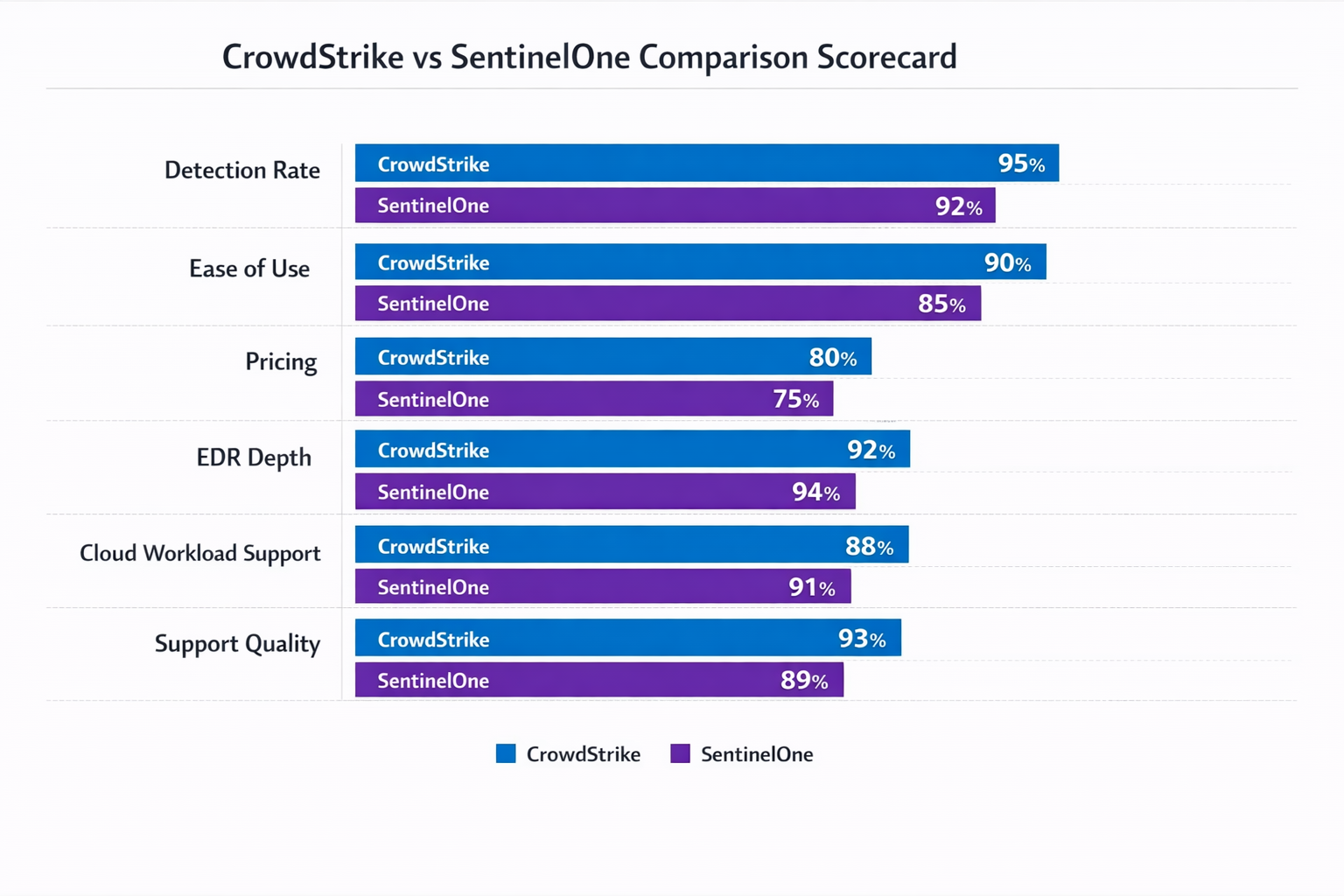
Both platforms score at the top of independent testing charts, but the details matter. In SE Labs’ 2024 Enterprise Endpoint Protection tests, both CrowdStrike and SentinelOne received AAA ratings, the highest available. AV-Comparatives’ 2024 Business Security Test showed similar results, with both platforms blocking over 99% of real-world threats.
Here’s what the independent testing actually shows:
| Test Category | CrowdStrike Falcon | SentinelOne Singularity |
|---|---|---|
| SE Labs AAA Rating (2024) | Yes | Yes |
| AV-Comparatives Real-World Protection | 99.7% | 99.5% |
| False Positive Rate | Very Low | Low |
| MITRE ATT&CK Evaluation | Top Tier | Top Tier |
| Response Automation | Requires higher tiers | Included at Control+ |
The MITRE ATT&CK evaluations are particularly useful here because they test how well platforms detect and document attack techniques, not just whether they block malware. Both vendors have performed well in recent MITRE rounds, though CrowdStrike has historically shown stronger visibility and detection analytics in those evaluations.
My honest read: the protection gap between these two platforms is small. You are not making a bad choice with either one. The real differentiators are architecture, ease of management, and price, not raw detection rates.
“At the top of the EDR market, protection rates are nearly equal. The decision comes down to how your team will actually use the platform day to day.”
CrowdStrike vs SentinelOne: Pricing and Plans Compared
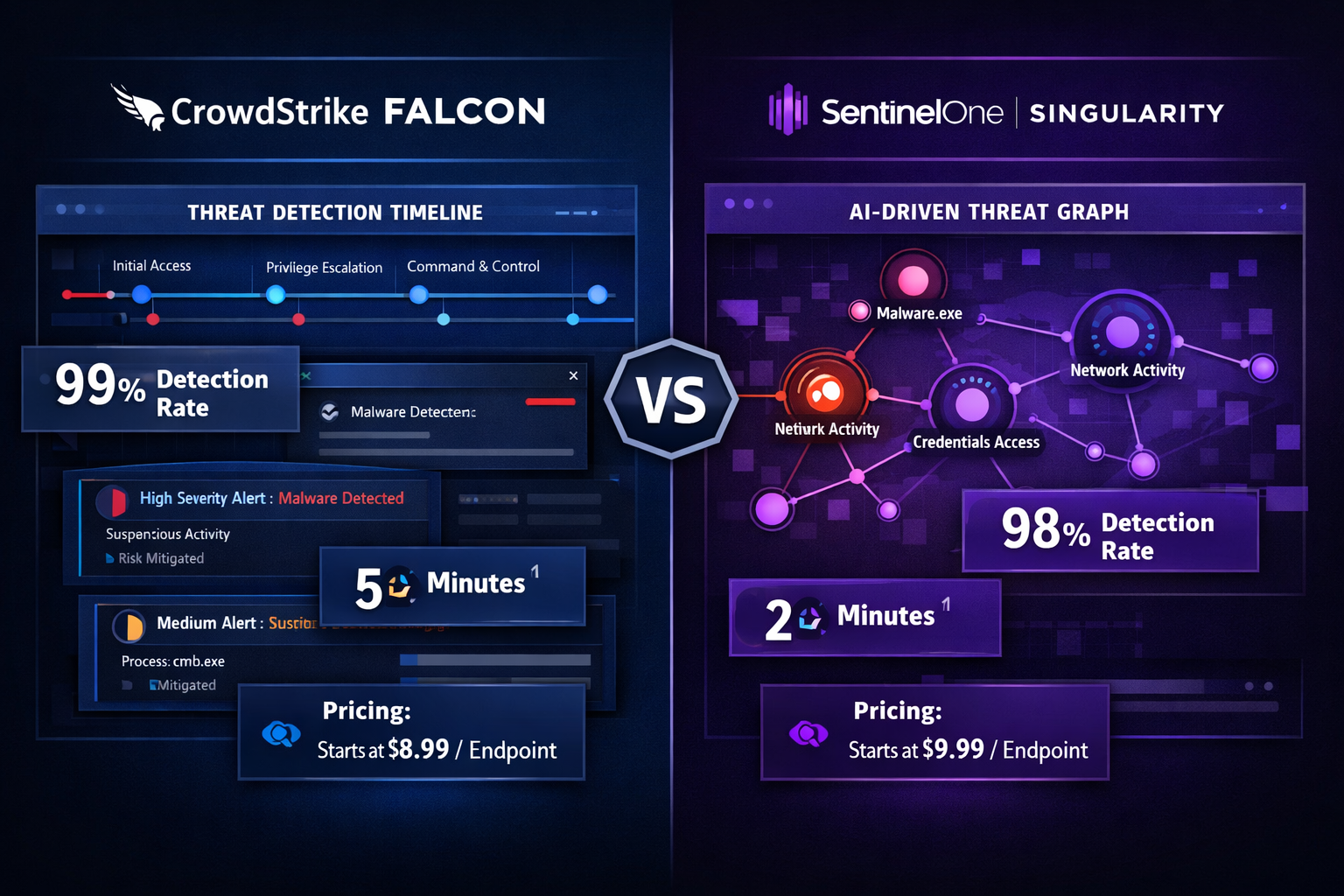
Neither vendor publishes fully transparent pricing, which is frustrating. Both use per-endpoint, per-year licensing with volume discounts. Here’s what you can realistically expect in 2026 based on publicly available information and reseller quotes.
CrowdStrike Falcon Plans (approximate):
- Falcon Go (SMB): ~$59.99/device/year. Basic next-gen antivirus, device control, firewall management.
- Falcon Pro: ~$99.99/device/year. Adds threat intelligence and USB control.
- Falcon Enterprise: ~$184.99/device/year. Full EDR, managed threat hunting, identity protection.
- Falcon Elite / Complete: Custom pricing. Adds MDR, full managed service.
SentinelOne Singularity Plans (approximate):
- Singularity Core: ~$45/device/year. Next-gen AV baseline.
- Singularity Control: ~$69.99/device/year. Adds EDR, device control, firewall.
- Singularity Complete: ~$159.99/device/year. Full EDR plus threat hunting, cloud workload protection.
- Singularity Commercial/Enterprise: Custom pricing. MDR, identity, CNAPP.
My take on pricing: SentinelOne gives you more EDR capability at lower tiers. The Control plan at roughly $70/device includes features that CrowdStrike reserves for its $185/device Enterprise tier. For SMBs watching budget, that gap is significant. For enterprises that want CrowdStrike’s intelligence network and managed services, the premium is often worth it.
Minimum seat counts apply at both vendors, typically 5 to 25 endpoints minimum depending on the reseller. Neither is a good fit for solo users or very small teams under 5 devices.
Which Platform Is Easier to Manage for SMBs?
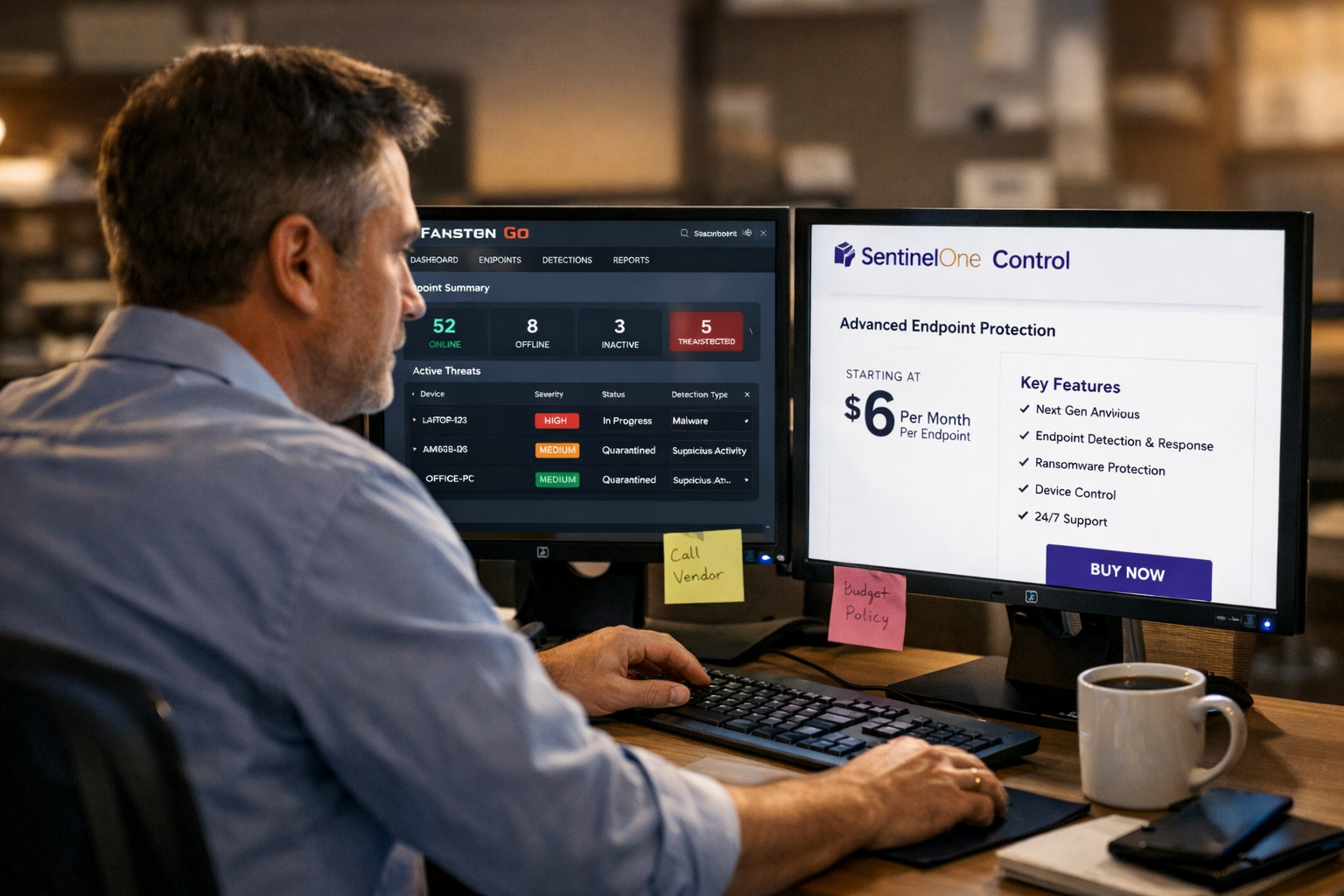
SentinelOne is easier to manage for teams without a dedicated security analyst. This is one of the clearest differentiators in the CrowdStrike vs SentinelOne comparison.
CrowdStrike’s console is powerful, but it rewards expertise. The Falcon platform surfaces enormous amounts of telemetry, threat intelligence, and detection data. For a skilled SOC analyst, that depth is invaluable. For an IT generalist at a 50-person company who also manages the phone system and the Wi-Fi, it can be overwhelming.
SentinelOne’s Singularity console is cleaner and more actionable. The platform’s AI makes autonomous decisions, quarantining threats and rolling back ransomware damage without requiring human intervention. That autonomous response capability is a genuine advantage for SMBs.
Choose CrowdStrike if:
- You have a dedicated security team or SOC.
- You want access to the deepest threat intelligence network in the industry.
- You’re running a large enterprise with complex compliance requirements.
- You value managed detection and response (MDR) services.
Choose SentinelOne if:
- You’re an SMB with limited IT staff.
- You need autonomous response without babysitting alerts.
- You want strong EDR capability without paying enterprise prices.
- You’re protecting cloud workloads and containers alongside endpoints.
For a broader look at how these platforms fit into your overall security stack, our guide to the best EDR solutions for SMBs covers additional options worth considering.
What Happened With the CrowdStrike Outage, and Should It Affect Your Decision?
Yes, it should factor into your evaluation, though not necessarily as a dealbreaker. In July 2024, a faulty content configuration update pushed by CrowdStrike caused approximately 8.5 million Windows devices to crash globally, according to Microsoft’s post-incident analysis. Airlines, hospitals, banks, and broadcasters were affected. It was one of the largest IT outages in history.
CrowdStrike responded quickly, issued a fix, and has since implemented additional update validation processes. But the incident exposed a real architectural risk: when a security vendor’s agent runs at the kernel level with automatic updates, a bad update can take down your entire fleet.
SentinelOne’s architecture does not operate at the same kernel level on Windows, which means a similar update failure would be less likely to cause a system-wide crash. That’s a legitimate technical advantage SentinelOne gained visibility for after the CrowdStrike incident.
What I’d tell any SMB owner evaluating this: the July 2024 outage was a wake-up call about vendor concentration risk. It doesn’t mean CrowdStrike is a bad product. It means you should ask both vendors about their update rollout policies, staged deployment options, and what happens when something goes wrong.
Understanding how to respond to a data breach or security incident is also worth reviewing regardless of which platform you choose.
CrowdStrike vs SentinelOne: Ransomware Protection Compared
Both platforms protect against ransomware, but SentinelOne’s automated rollback is a standout feature. Ransomware protection is one of the most important things to evaluate in any endpoint security platform, and the two vendors handle it differently.
CrowdStrike detects ransomware behavior and can block it in real time. At higher tiers, it includes Falcon Overwatch, a managed threat hunting service that proactively looks for signs of compromise. However, automated file rollback (restoring encrypted files to their pre-attack state) is not a standard feature at entry-level Falcon tiers.
SentinelOne includes its Storyline technology at the Control tier and above, which maps every process and file change on an endpoint. If ransomware starts encrypting files, SentinelOne can detect the behavior, kill the process, and roll back the encrypted files to their clean state, automatically, without human intervention. That’s a meaningful capability for a business without a 24/7 SOC.
For a deeper look at the ransomware threat landscape and how to layer your defenses, our guide on how to protect against ransomware is worth reading alongside this comparison.
How Do the Two Platforms Handle Cloud and Container Security?
SentinelOne has the edge here at comparable price points. Cloud workload protection and container security have become critical as more SMBs and enterprises move infrastructure to AWS, Azure, and Google Cloud.
CrowdStrike offers strong cloud security through its Falcon Cloud Security module, but it’s typically an add-on that pushes costs higher. Container runtime protection and Kubernetes security are available, but you’ll pay for them separately.
SentinelOne’s Singularity Complete tier includes cloud workload protection and container security as part of the package. If you’re running Docker containers or Kubernetes clusters alongside traditional endpoints, SentinelOne gives you more coverage for the money at that tier.
For teams running workloads on AWS, pairing either platform with solid AWS security best practices is essential.
What Do Real Users and IT Professionals Say About Each Platform?
User reviews on G2, Gartner Peer Insights, and Reddit’s r/netsec community paint a consistent picture. CrowdStrike users praise its threat intelligence, the quality of Falcon Overwatch, and the depth of its detection analytics. Common complaints center on cost, console complexity, and the post-2024 trust questions around update reliability.
SentinelOne users consistently highlight ease of management, autonomous response, and the value of the rollback feature. Complaints tend to focus on support responsiveness at lower tiers and occasional false positives that require tuning.
From my own evaluation and the community feedback I’ve tracked, here’s the honest summary:
- CrowdStrike earns loyalty from enterprise security teams who use it deeply. It’s a platform that rewards investment in learning it.
- SentinelOne earns loyalty from IT generalists and SMB owners who want strong protection without becoming security experts.
Neither platform has a perfect support reputation. Both have been criticized for slow ticket resolution at standard support tiers. If support quality matters to you, factor in the cost of premium support packages at both vendors.
Are There Alternatives Worth Considering?
Yes. CrowdStrike and SentinelOne are the top two, but they’re not the only options. Microsoft Defender for Endpoint has become a serious competitor, especially for organizations already in the Microsoft 365 ecosystem. Our CrowdStrike vs Microsoft Defender comparison covers that matchup in detail.
For SMBs looking at the full landscape of endpoint security options, our best endpoint security for business guide covers additional platforms including Sophos, Bitdefender, and Malwarebytes for Teams.
If budget is the primary constraint, our best antivirus for small business guide covers more affordable options that still provide meaningful protection.
Frequently Asked Questions
Q: Is CrowdStrike better than SentinelOne?
Neither is universally better. CrowdStrike is stronger for enterprises with security teams. SentinelOne is more practical for SMBs that need autonomous protection without dedicated analysts.
Q: Can SentinelOne replace CrowdStrike?
Yes, for most use cases. SentinelOne covers the same core EDR functionality and adds autonomous response at lower price points. Enterprises that rely heavily on CrowdStrike’s Threat Intelligence integrations may find the switch requires adjustment.
Q: Did the 2024 CrowdStrike outage permanently damage its reputation?
It raised legitimate questions about update management and kernel-level risk. CrowdStrike has since added staged rollout controls. Most enterprise customers stayed with the platform, but the incident is a fair factor to include in any evaluation.
Q: Does SentinelOne work without an internet connection?
Yes. Because SentinelOne’s AI model runs on the endpoint agent itself, it can detect and respond to threats even when offline. CrowdStrike relies more heavily on cloud connectivity for full functionality.
Q: Which platform is better for ransomware protection?
SentinelOne’s automated rollback feature gives it a practical edge for ransomware response, especially for SMBs. CrowdStrike’s proactive threat hunting through Falcon Overwatch is excellent but costs more.
Q: What is the minimum number of endpoints for each platform?
Both vendors typically require a minimum of 5 to 25 endpoints depending on the plan and reseller. Neither is designed for individual consumers.
Q: Does CrowdStrike offer a free trial?
CrowdStrike offers a 15-day free trial for Falcon Go and Falcon Pro through its website. SentinelOne offers demo access but free trials typically require contacting sales.
Q: Which platform has better Linux support?
Both support major Linux distributions. SentinelOne’s Linux agent is generally considered more lightweight and has broader distribution support, which matters for DevOps and server-heavy environments.
Q: Is SentinelOne good for healthcare or financial services?
Yes. SentinelOne supports HIPAA, PCI-DSS, and SOC 2 compliance requirements. CrowdStrike also supports these frameworks. Both are used extensively in regulated industries.
Q: How does pricing scale with more endpoints?
Both vendors offer volume discounts. Generally, the per-device cost drops meaningfully at 100+ endpoints and again at 500+. Always negotiate, especially for multi-year contracts.
Q: Which platform integrates better with SIEM tools?
CrowdStrike has deeper native integrations with Splunk, Microsoft Sentinel, and other enterprise SIEMs. SentinelOne integrates well too, but CrowdStrike’s ecosystem is broader for large SOC environments.
Q: Should I use EDR alone or pair it with other tools?
EDR is your first line of defense for endpoints, but it shouldn’t stand alone. Pair it with multi-factor authentication, email security, and a solid backup strategy for layered protection.
Conclusion: Which One Should You Choose?
The CrowdStrike vs SentinelOne decision comes down to two things: your team’s capacity and your budget.
If you’re running an SMB with 10 to 250 endpoints and your IT team is one or two people who handle everything, SentinelOne is my recommendation. The autonomous response, the ransomware rollback, and the cleaner management console mean you get enterprise-grade protection without needing a dedicated security analyst to get value from it. The Singularity Control tier gives you real EDR capability at a price that makes sense for smaller organizations.
If you’re running a mid-to-large enterprise with a dedicated security team or SOC, CrowdStrike is the stronger platform. The depth of its threat intelligence, the quality of Falcon Overwatch, and its ecosystem integrations make it the preferred choice for organizations that can invest in using it fully. Just build staged update policies into your deployment from day one.
Both platforms are tested and verified by independent labs. Both will catch threats that traditional antivirus misses. The difference is in how much work your team has to do to stay protected.
My action for you today: request a trial or demo from whichever platform fits your profile above. Run it against your actual environment for two weeks. Pay attention to how many alerts need manual review, how long setup took, and whether the console makes sense to your team. That real-world experience will tell you more than any comparison article can.
For a deeper dive into each platform individually, see our full SentinelOne review and CrowdStrike Falcon review.
References
- SE Labs. “Enterprise Endpoint Protection.” SE Labs Annual Report, 2024. https://selabs.uk
- AV-Comparatives. “Business Security Test 2024.” AV-Comparatives, 2024. https://www.av-comparatives.org
- Microsoft. “Helping our customers through the CrowdStrike outage.” Microsoft Blog, July 2024. https://blogs.microsoft.com
- MITRE ATT&CK Evaluations. “Enterprise Evaluations Round 6.” MITRE, 2024. https://attackevals.mitre-engenuity.org
- Gartner Peer Insights. “Endpoint Protection Platforms Reviews.” Gartner, 2024. https://www.gartner.com/reviews/market/endpoint-protection-platforms
- CrowdStrike. “Falcon Platform Pricing.” CrowdStrike, 2025. https://www.crowdstrike.com
- SentinelOne. “Singularity Platform Pricing.” SentinelOne, 2025. https://www.sentinelone.com
Schema Markup (JSON-LD):
<code class="language-json">{
  "@context": "https://schema.org",
  "@type": "Article",
  "headline": "CrowdStrike vs SentinelOne: Which EDR Platform Actually Protects Your Business in 2026?",
  "datePublished": "2026-04-19",
  "dateModified": "2026-04-19",
  "author": {
    "@type": "Organization",
    "name": "Sybari"
  },
  "publisher": {
    "@type": "Organization",
    "name": "Sybari",
    "url": "https://sybari.com"
  },
  "mainEntityOfPage": {
    "@type": "WebPage",
    "@id": "https://sybari.com/crowdstrike-vs-sentinelone/"
  },
  "description": "Independent comparison of CrowdStrike Falcon vs SentinelOne Singularity for 2026. Covers pricing, detection rates, ransomware protection, ease of use, and which platform is right for SMBs vs enterprises.",
  "about": [
    {"@type": "Thing", "name": "CrowdStrike Falcon"},
    {"@type": "Thing", "name": "SentinelOne Singularity"},
    {"@type": "Thing", "name": "Endpoint Detection and Response"},
    {"@type": "Thing", "name": "Cybersecurity"}
  ]
}
</code>
<code class="language-json">{
"@context": "https://schema.org",
"@type": "FAQPage",
"mainEntity": [
{
"@type": "Question",
"name": "Is CrowdStrike better than SentinelOne?",
"acceptedAnswer": {
"@type": "Answer",
"text": "Neither is universally better. CrowdStrike is stronger for enterprises with security teams. SentinelOne is more practical for SMBs that need autonomous protection without dedicated analysts."
}
},
{
"@type": "Question",
"name": "Did the 2024 CrowdStrike outage permanently damage its reputation?",
"acceptedAnswer": {
"@type": "Answer",
"text": "It raised legitimate questions about update management and kernel-level risk. CrowdStrike has since added staged rollout controls. Most enterprise customers stayed with the platform, but the incident is a fair factor to include in any evaluation."
}
},
{
"@type": "Question",
"name": "Which platform is better for ransomware protection?",
"acceptedAnswer": {
"@type": "Answer",
"text": "SentinelOne's automated rollback feature gives it a practical edge for ransomware response, especially for SMBs. CrowdStrike's proactive threat hunting through Falcon Overwatch is excellent but costs more."
}
}
]
}
</code>