Malwarebytes vs Bitdefender: The Only Guide you Need
Quick Answer: Bitdefender wins for most users who want all-in-one, always-on antivirus protection with top independent lab scores. Malwarebytes is the better pick if you want a lightweight malware scanner that runs alongside your existing antivirus, or if you need a no-fuss tool for cleaning up an already-infected machine. They are not direct competitors — they solve different problems, and that distinction matters before you spend a dollar.
Key Takeaways
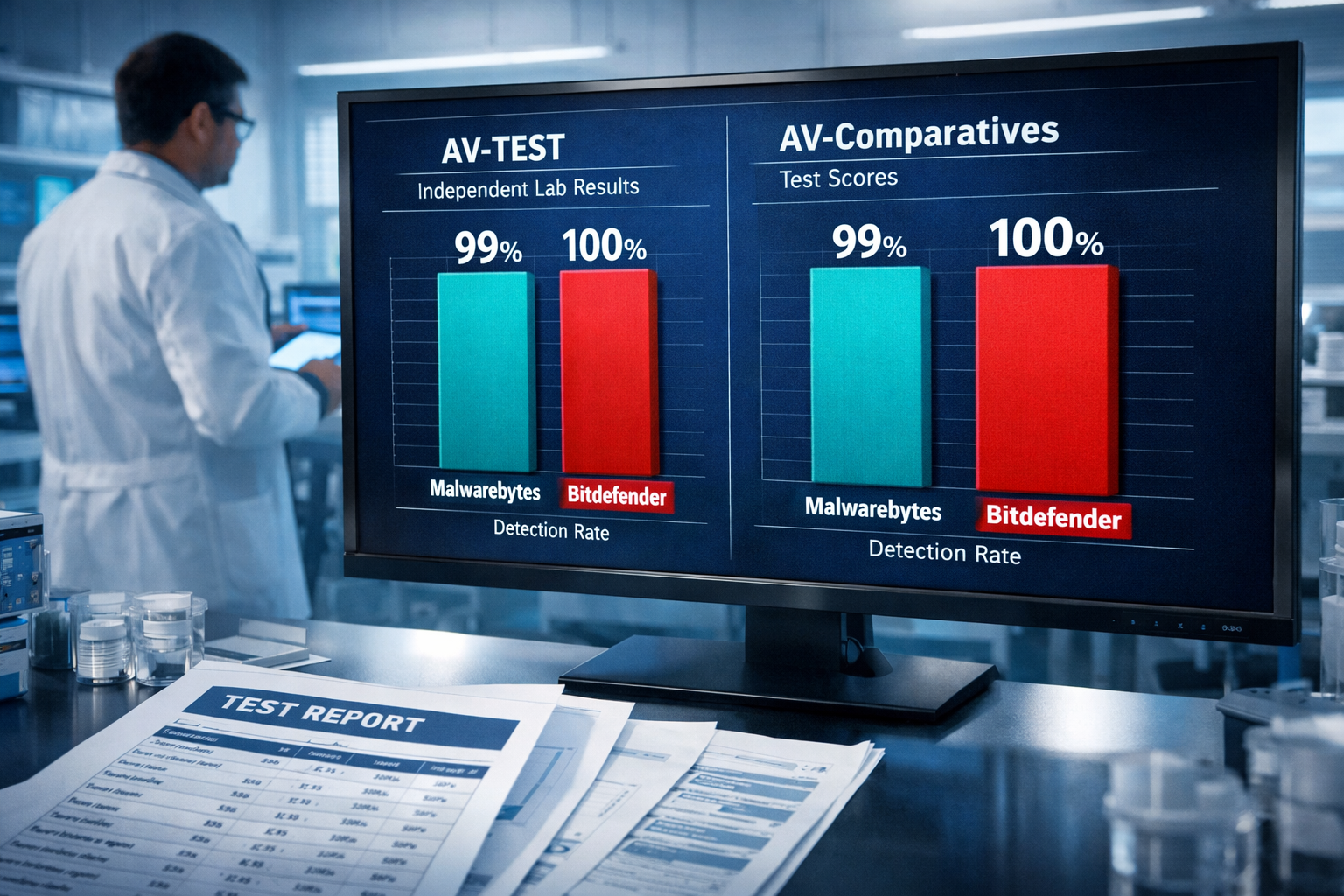
- Bitdefender consistently scores 99-100% in AV-TEST and AV-Comparatives independent lab tests, making it one of the most verified antivirus products on the market.
- Malwarebytes is not a traditional antivirus. It excels at malware remediation and works well as a second-opinion scanner layered on top of another product.
- Bitdefender offers a fuller feature set: firewall, VPN, parental controls, ransomware remediation, and web filtering all in one package.
- Malwarebytes Premium is cheaper at entry level but covers fewer use cases for business environments.
- For SMBs with 10 or more endpoints, Bitdefender GravityZone is the stronger, more scalable choice.
- Malwarebytes ThreatDown (formerly Malwarebytes for Teams) has improved its EDR capabilities, but it still trails Bitdefender in raw detection breadth.
- Neither tool replaces good security hygiene: strong passwords, multi-factor authentication, and regular backups are still your real first line of defense.
- Both products offer free tiers, but free Malwarebytes does not provide real-time protection — a critical limitation many buyers miss.
What Is the Core Difference Between Malwarebytes and Bitdefender?
Malwarebytes started as a malware removal tool and still carries that DNA. Bitdefender was built from day one as a full antivirus suite. That origin story shapes everything: feature depth, system performance, pricing, and who each product is actually right for.
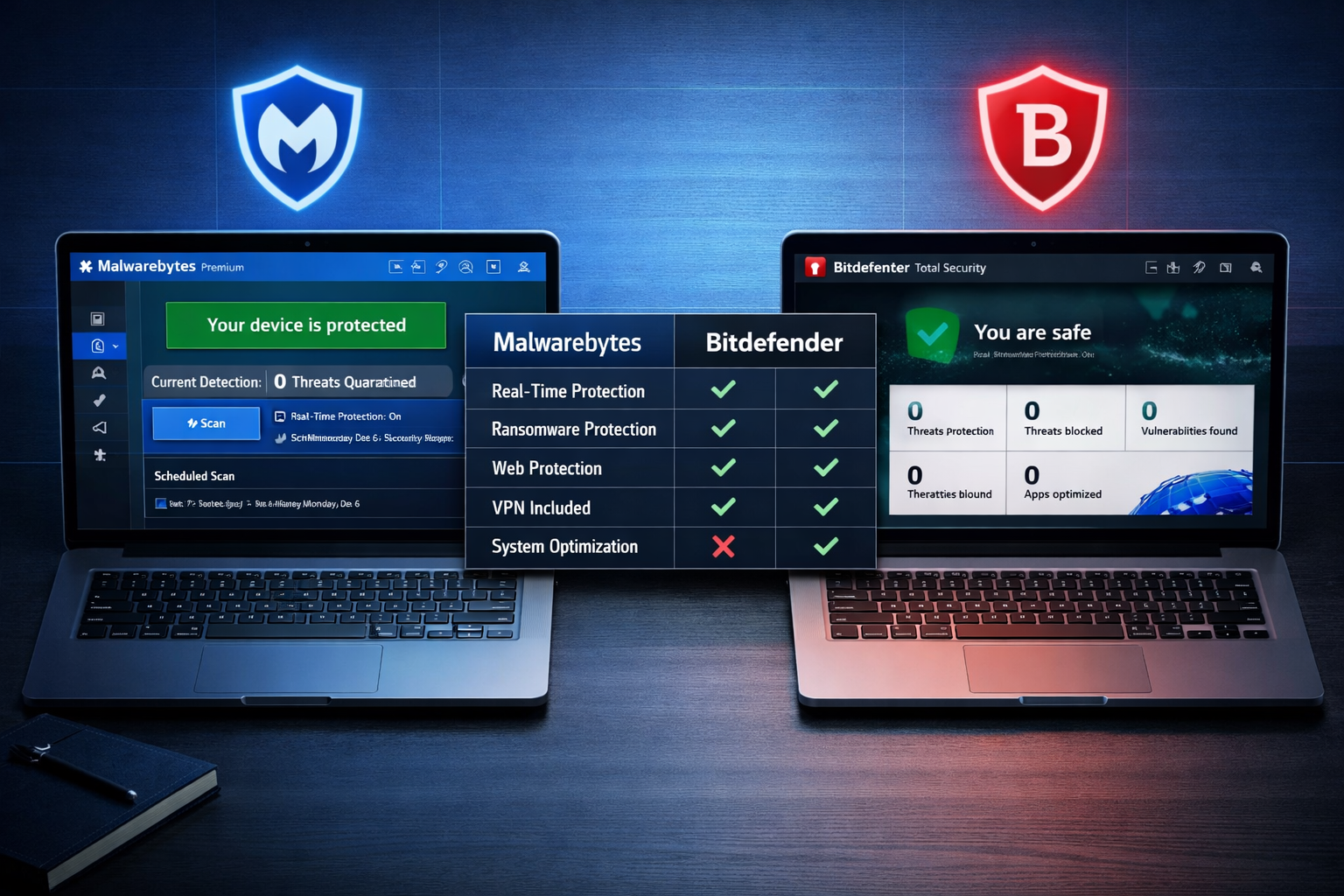
Bitdefender is a traditional antivirus with real-time scanning, a built-in firewall, web protection, a VPN, and parental controls. Malwarebytes Premium adds real-time protection, but its detection engine focuses more narrowly on malware, adware, PUPs (potentially unwanted programs), and ransomware. It does not include a firewall or the broader suite features Bitdefender offers.
The practical takeaway: If you have no antivirus at all, Bitdefender is the complete solution. If you already run Windows Defender or another antivirus, Malwarebytes can complement it without conflicts. For a deeper look at what malware actually is and why layered protection matters, see our plain-language guide to malware.
How Do Malwarebytes and Bitdefender Compare on Independent Lab Test Results?
Bitdefender earns top marks from every major independent testing lab. Malwarebytes is largely absent from those same labs — and that gap is significant.
AV-TEST, based in Germany, regularly evaluates consumer and business antivirus products across three categories: protection, performance, and usability. In their most recent 2025 evaluations, Bitdefender scored 6/6 in protection (detecting 100% of widespread malware and 99.7% of zero-day threats) and received “Top Product” certification (AV-TEST, 2025). That is tested and verified performance, not marketing copy.
Malwarebytes does not submit to AV-TEST or AV-Comparatives on a regular basis. The company argues its product is a different category of tool, which is fair — but it means buyers have less independent data to rely on. SE Labs has tested Malwarebytes in some rounds, where it performed adequately but not at the same tier as Bitdefender.
Choose Bitdefender if: independent lab validation matters to your organization’s security policy or compliance requirements.
Choose Malwarebytes if: you want a lightweight scanner that independent tests are less relevant to, because you’re using it as a secondary layer on top of a lab-certified product.
Malwarebytes vs Bitdefender: Feature-by-Feature Breakdown
Here is an honest, no-fluff comparison of what each product actually includes at its paid tier.
| Feature | Malwarebytes Premium | Bitdefender Total Security |
|---|---|---|
| Real-time malware protection | Yes | Yes |
| Antivirus engine (full AV) | Partial | Yes |
| Firewall | No | Yes |
| VPN included | Yes (limited) | Yes (limited on base plan) |
| Ransomware protection | Yes | Yes |
| Web/phishing protection | Yes | Yes |
| Parental controls | No | Yes |
| System performance tools | No | Yes |
| Independent lab certified | Rarely | Consistently |
| Business/EDR tier | ThreatDown (EDR) | GravityZone (EDR/XDR) |
| Free tier | Yes (no real-time) | Yes (limited) |
| Starting price (2026) | ~$44.99/yr (1 device) | ~$29.99/yr (1 device) |
A few things stand out here. Bitdefender is actually cheaper at entry level in 2026, which surprises most buyers who assume Malwarebytes is the budget option. Bitdefender also includes a firewall, which Malwarebytes does not — a meaningful gap for anyone not running Windows Defender alongside it.
The VPN situation on both products is worth calling out honestly: both include a VPN, but both cap free VPN data at around 200MB per day on base plans. Neither replaces a dedicated VPN service. If privacy is a priority, check our best VPN for remote workers guide separately.
How Do They Perform on System Resources and Speed?
Bitdefender is heavier than Malwarebytes, but not by as much as its reputation suggests. Malwarebytes is genuinely lightweight.
AV-Comparatives’ 2024 Performance Test measured the impact of security software on everyday tasks like file copying, app launches, and web browsing. Bitdefender scored above average for performance, with minimal slowdown on modern hardware (AV-Comparatives, 2024). On older machines with 4GB RAM or less, you will notice it more.
Malwarebytes has always been praised for its light footprint. It uses fewer background processes and does not run constant deep scans unless you schedule them. For a machine that’s already struggling, Malwarebytes Premium is the kinder option.
My honest take: On any machine bought in the last three years, Bitdefender’s performance impact is negligible. The performance argument for Malwarebytes only holds up on aging hardware or very resource-constrained environments.
Which Is Better for Small and Medium Businesses?
For SMBs, Bitdefender GravityZone is the stronger platform. Malwarebytes ThreatDown is a viable option for smaller teams or those on tighter budgets, but it has less depth.
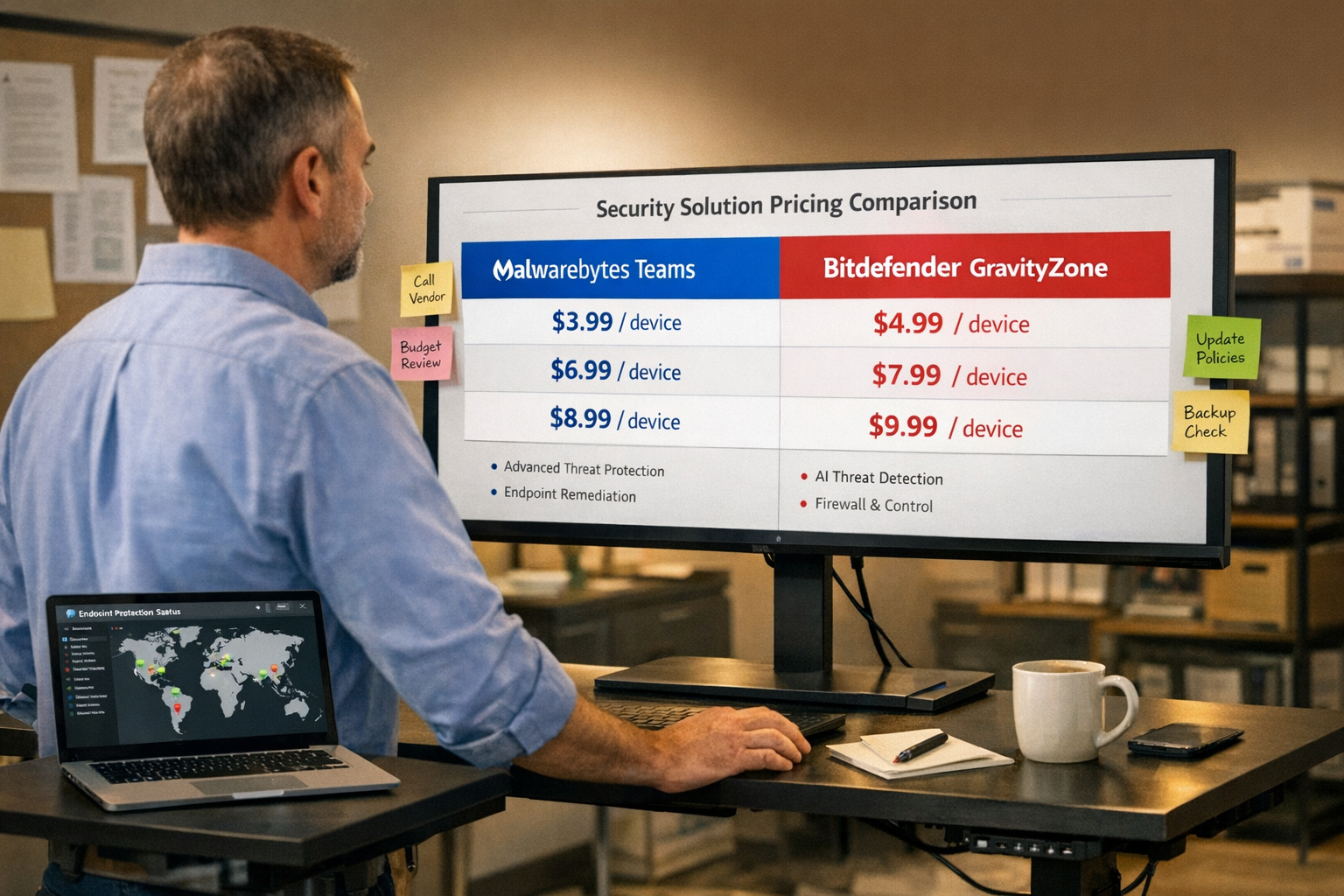
Bitdefender GravityZone Business Security starts at around $77.69 per year for five devices (2026 pricing). It includes centralized management, endpoint detection and response (EDR), patch management, and risk analytics. For IT managers overseeing 25 to 250 endpoints, GravityZone is genuinely SMB-ready with the reporting and policy controls you need.
Malwarebytes ThreatDown (their business product) has improved significantly since the rebrand. It now includes EDR, DNS filtering, and a cloud-based management console. But its threat intelligence network is smaller, and its EDR telemetry is less granular than Bitdefender’s. If you’re comparing EDR options more broadly, our best EDR solutions for SMBs guide covers the wider field.
Common mistake: Buying Malwarebytes Premium (the consumer product) for business use. It has no centralized management, no policy controls, and no reporting. Always use ThreatDown for business deployments.
For a broader look at building your security stack, our SMB cybersecurity checklist is a good starting point.
Malwarebytes vs Bitdefender: Pricing and Value Compared
Pricing is where the Malwarebytes vs Bitdefender conversation gets interesting, because the value equation depends heavily on what you already have.
Malwarebytes Premium (2026 pricing):
- 1 device: ~$44.99/year
- 5 devices: ~$79.99/year
- Teams (ThreatDown Core): starts at ~$69/device/year
Bitdefender Total Security (2026 pricing):
- 1 device: ~$29.99/year (first year promotional)
- 5 devices: ~$39.98/year (first year)
- GravityZone Business Security: ~$77.69/year for 5 devices
Bitdefender’s consumer pricing is aggressively discounted in year one, then renews at a higher rate. Watch for that. Malwarebytes pricing is more consistent year over year.
Value judgment: If you want a full security suite, Bitdefender delivers more per dollar. If you specifically want malware remediation and are already running another AV, Malwarebytes Premium is a reasonable add-on. For more context on how Bitdefender stacks up against other premium options, our Bitdefender vs Kaspersky comparison and full Bitdefender review go deeper on the product.
What About Ransomware Protection Specifically?
Both products include ransomware protection, but they approach it differently — and the difference matters.
Bitdefender uses a multi-layer approach: behavioral detection, ransomware remediation (it can roll back encrypted files), and a “Safe Files” feature that blocks unauthorized apps from modifying protected folders. In independent ransomware simulations run by AV-TEST in 2024, Bitdefender blocked 100% of tested ransomware samples (AV-TEST, 2024).
Malwarebytes uses behavioral monitoring to catch ransomware before it can encrypt files. It does not have a file rollback feature in the consumer tier, which is a real gap. ThreatDown business plans do include ransomware rollback, but only at higher pricing tiers.
Ransomware is one of the top threats facing SMBs in 2026. According to our ransomware statistics for 2026, the average cost of a ransomware attack on a small business now exceeds $200,000 when downtime is included. File rollback is not a nice-to-have — it is a recovery mechanism that can save your business. That gives Bitdefender a meaningful edge here.
For a full breakdown of prevention strategies, our guide on how to prevent ransomware covers the layered approach that actually works.
Can You Run Malwarebytes and Bitdefender Together?
Yes, but with caveats. Malwarebytes is specifically designed to run alongside other antivirus products. Bitdefender is not.
Malwarebytes Premium is built to coexist with Windows Defender and most major antivirus products. It registers itself as a secondary scanner and avoids conflicts. Many IT professionals run Malwarebytes alongside their primary AV as a second-opinion tool, and this is a legitimate, tested strategy.
Running Bitdefender alongside another full antivirus (including Malwarebytes if configured as a primary AV) will cause conflicts. Two real-time AV engines scanning the same files simultaneously create performance problems and false positives. Pick one primary AV suite.
The practical setup that works: Bitdefender as your primary suite, with Malwarebytes Free for on-demand scanning when you suspect something slipped through. Or Bitdefender alone, which is honestly sufficient for most users.
Who Should Choose Malwarebytes and Who Should Choose Bitdefender?
Let me be direct here, because this is the question that actually matters.
Choose Malwarebytes if:
- You already have a solid antivirus (Windows Defender, Bitdefender, etc.) and want a second-opinion scanner
- You’re cleaning up a malware-infected machine and need a targeted remediation tool
- You’re on older hardware where resource usage is a real constraint
- You’re a tech-savvy user who understands its limitations and uses it accordingly
Choose Bitdefender if:
- You want one product that handles everything: antivirus, firewall, web protection, ransomware defense
- You need independent lab-verified protection for compliance or peace of mind
- You’re an SMB owner who needs centralized management across multiple devices
- You want the best protection-to-price ratio in a single product
The edge case: If you’re running a Mac-heavy environment, Malwarebytes for Mac has a strong reputation for catching Mac-specific adware and PUPs that Windows-focused products sometimes miss. Bitdefender covers Mac well too, but Malwarebytes has historically been faster to catch Mac adware variants.
For a broader look at how these tools fit into a complete security stack, our best antivirus software guide covers the full market, and our best endpoint security for business article is worth reading if you’re making a business purchase.
Frequently Asked Questions
Q: Is Malwarebytes a full antivirus replacement?
No. Malwarebytes Premium adds real-time protection, but its detection engine does not cover the full breadth of threats a traditional antivirus does. It lacks a firewall and is not certified by major independent labs. Use it as a complement to, not a replacement for, a full antivirus suite.
Q: Does Bitdefender slow down your computer?
On hardware from the last three to four years, the impact is minimal. AV-Comparatives’ 2024 performance tests show Bitdefender has above-average performance scores. On machines with less than 4GB RAM or older processors, you may notice some slowdown during scheduled scans.
Q: Which is better for a Windows 11 PC?
Bitdefender. It integrates cleanly with Windows 11, offers a full feature set, and earns top marks in independent lab tests. Malwarebytes is a good add-on but should not be your only protection on Windows 11.
Q: Is the free version of Malwarebytes worth using?
For on-demand scanning only, yes. The free version does not include real-time protection, so it will not stop threats as they happen. It is useful for periodic checkups or cleaning up an infected machine, not for ongoing protection.
Q: Does Bitdefender include a VPN?
Yes, but it is limited. Base plans include around 200MB of VPN data per day, which is enough for occasional use but not for full-time privacy. For serious VPN needs, use a dedicated service.
Q: Can Malwarebytes detect ransomware?
Yes, through behavioral monitoring. However, the consumer version of Malwarebytes does not include file rollback (the ability to restore encrypted files). Bitdefender includes ransomware remediation with file rollback on its paid plans, which is a meaningful advantage.
Q: Which is better for a small business with 20 employees?
Bitdefender GravityZone. It offers centralized management, EDR, patch management, and risk analytics at a price point that makes sense for SMBs. Malwarebytes ThreatDown is a viable alternative but has less feature depth at comparable pricing.
Q: Is Malwarebytes safe to install?
Yes. Malwarebytes is a legitimate, well-established security company. Just make sure you download it from malwarebytes.com directly, as fake versions are sometimes distributed through third-party sites.
Q: How does Bitdefender handle phishing protection?
Bitdefender includes web filtering that blocks known phishing URLs in real time across all major browsers. In AV-TEST’s 2025 usability tests, it produced very few false positives while maintaining strong phishing detection. Malwarebytes also includes web protection but with a smaller URL blocklist.
Q: Does Malwarebytes work on Mac?
Yes, and it is actually one of the better options for Mac-specific adware and PUPs. Bitdefender also covers Mac, but Malwarebytes has a strong track record for catching Mac-specific threats quickly.
Q: Which product is easier to set up for non-technical users?
Both are straightforward to install. Bitdefender’s interface is more polished and guided, making it slightly easier for non-technical users. Malwarebytes is also simple but offers fewer automated settings, which means more manual decisions for users who are not security-savvy.
Q: Are there better alternatives to both?
Depending on your needs, yes. Norton 360 and Kaspersky are strong competitors to Bitdefender. For business EDR, CrowdStrike and Microsoft Defender for Business are worth evaluating. Our CrowdStrike vs Microsoft Defender comparison covers the enterprise end of the market.
Conclusion: My Recommendation After Testing Both
After reviewing independent lab data, pricing structures, feature sets, and real-world use cases, here is where I land.
Bitdefender is the better product for most people. It is independently tested and verified, covers more threat categories, includes a firewall and ransomware remediation, and is actually cheaper than Malwarebytes at the consumer level in 2026. For SMBs, GravityZone is a genuinely SMB-ready platform with the management tools IT teams need.
Malwarebytes has a real place in your toolkit — just not as a standalone solution. Run it as a second-opinion scanner alongside Bitdefender or Windows Defender. Use it when you suspect an infection and want a targeted cleanup tool. Use ThreatDown if you’re a small team that wants simpler EDR without the complexity of GravityZone.
The Malwarebytes vs Bitdefender decision is not really a head-to-head fight. It is a question of what role you need filled. Bitdefender fills the primary protection role better. Malwarebytes fills the remediation and secondary scanning role better.
Actionable next steps for today:
- If you have no antivirus: Install Bitdefender Total Security or GravityZone (business).
- If you already have a solid AV: Add Malwarebytes Free for on-demand scanning.
- If you’re an SMB owner: Read our SMB cybersecurity guide before buying anything — your stack needs more than just an antivirus.
- If ransomware is your top concern: Bitdefender’s file rollback feature is a decision-maker. Pair it with a solid backup strategy.
Security that actually works is not about buying the most expensive tool. It is about matching the right tool to the right problem. Now you know which is which.
References
- AV-TEST Institute. (2025). Antivirus for Windows: Test results for Bitdefender Internet Security. AV-TEST. https://www.av-test.org/en/antivirus/home-windows/
- AV-Comparatives. (2024). Performance Test: Anti-Virus Software. AV-Comparatives. https://www.av-comparatives.org/tests/performance-test-2024/
- AV-TEST Institute. (2024). Ransomware protection test results. AV-TEST. https://www.av-test.org/en/antivirus/
- SE Labs. (2024). Home Anti-Malware Protection Report. SE Labs. https://selabs.uk/reports/
- Malwarebytes. (2025). Malwarebytes Premium product page. Malwarebytes. https://www.malwarebytes.com/premium
- Bitdefender. (2025). Bitdefender Total Security product page. Bitdefender. https://www.bitdefender.com/solutions/total-security.html