ProtonVPN vs NordVPN: Privacy-First Showdown
Quick Answer
ProtonVPN wins on pure privacy credentials. NordVPN wins on speed and server variety. If your top priority is keeping data out of government hands and you want open-source, audited software, choose ProtonVPN. If you want faster connections and a larger server network for streaming or business use, NordVPN is the stronger pick.
Key Takeaways
- ProtonVPN is based in Switzerland and operates under some of the world’s strongest privacy laws, making it harder for governments to compel data disclosure.
- NordVPN is incorporated in Panama, also outside major intelligence-sharing alliances, but has a larger server network (6,000+ servers vs. ProtonVPN’s 9,000+ servers as of 2026).
- Both providers have passed independent no-logs audits, but ProtonVPN publishes fully open-source apps, which allows community verification.
- NordVPN consistently outperforms ProtonVPN on speed benchmarks in independent testing, particularly on its NordLynx (WireGuard-based) protocol.
- ProtonVPN’s free tier is the only genuinely no-logs, no-ads free VPN plan from a credible provider.
- For SMB owners, NordVPN’s Teams product offers easier centralized management. ProtonVPN for Business is a solid alternative with stronger privacy defaults.
- Neither VPN is perfect. Both have had past incidents worth knowing about before you buy.

How Do ProtonVPN and NordVPN Compare on Privacy?
ProtonVPN has the stronger privacy foundation. It is headquartered in Geneva, Switzerland, which sits outside the EU, the US, and the Five Eyes, Nine Eyes, and Fourteen Eyes intelligence-sharing alliances. Swiss law requires a formal legal process before any user data can be shared, and even then, ProtonVPN’s no-logs architecture means there is little useful data to hand over.
NordVPN is registered in Panama, which also has no mandatory data retention laws and sits outside intelligence-sharing alliances. That is a genuinely good jurisdiction. But ProtonVPN goes one step further by publishing all of its apps as open-source code on GitHub, so independent researchers can verify what the software actually does. NordVPN’s apps are not fully open-source.
Key privacy differences at a glance:
| Factor | ProtonVPN | NordVPN |
|---|---|---|
| Jurisdiction | Switzerland | Panama |
| Open-source apps | Yes (all platforms) | No |
| No-logs audit | Yes (Securitum, 2023) | Yes (Deloitte, 2023) |
| RAM-only servers | No (select servers) | Yes (all servers) |
| Warrant canary | Yes | Yes |
| Tor over VPN | Yes (Onion over VPN) | Yes |
Bottom line on privacy: Both are credible choices. ProtonVPN edges ahead because open-source code is independently verifiable. Audits are snapshots in time. Code you can read is ongoing accountability.
Common mistake: Assuming “no-logs” means identical privacy across all providers. The jurisdiction, the audit firm, and the app’s source code transparency all matter. Check all three, not just the marketing claim.
ProtonVPN vs NordVPN: Which Is Faster?
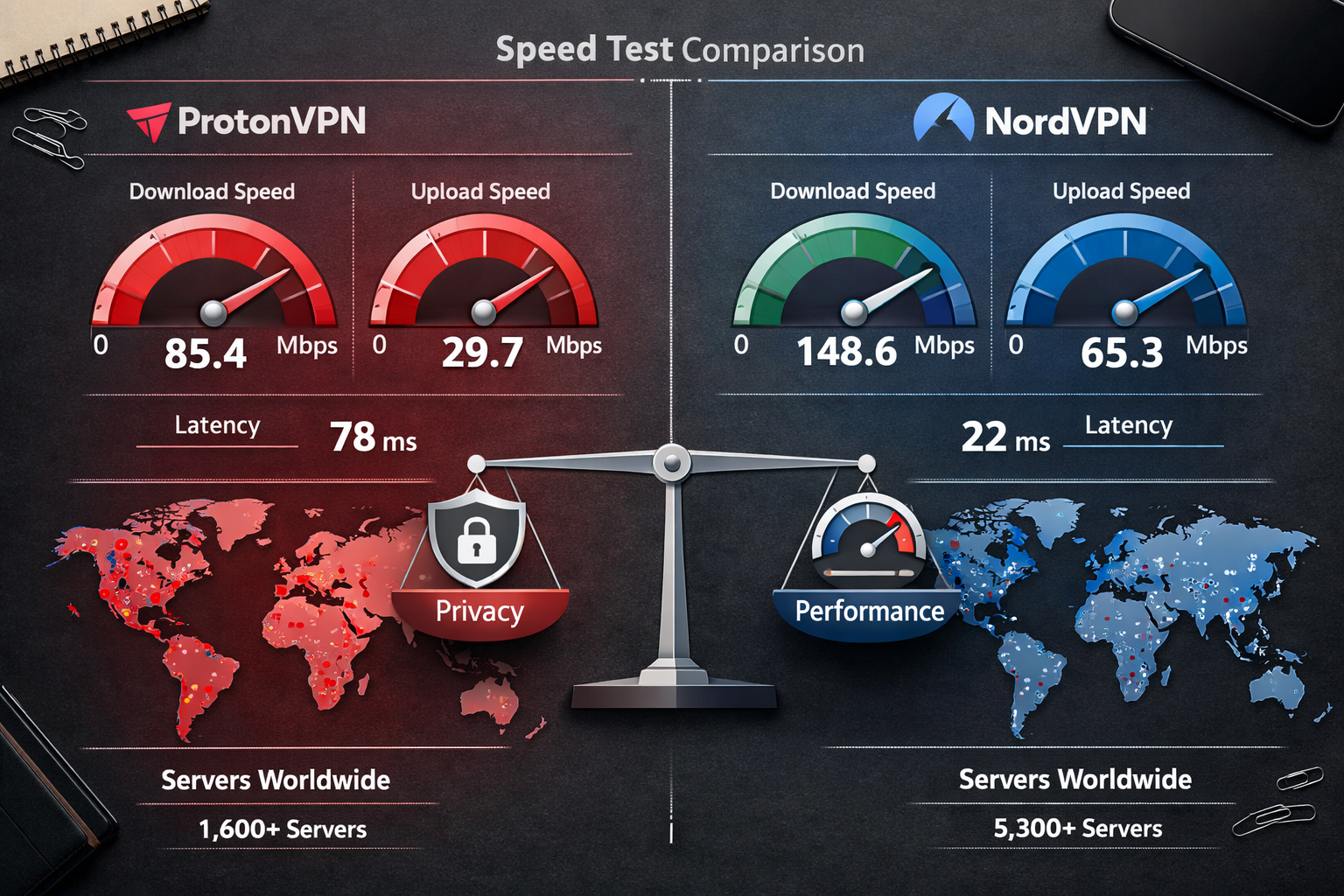
NordVPN is faster in most independent speed tests. Its NordLynx protocol, built on WireGuard, regularly delivers download speeds that are 10 to 20 percent faster than ProtonVPN’s WireGuard implementation in head-to-head tests conducted by reviewers at PCMag and Tom’s Guide in 2024 and 2025.
ProtonVPN is not slow. On its Stealth protocol (designed to bypass VPN blocking), speeds are competitive. But if raw throughput matters for your business, such as large file transfers, video conferencing, or 4K streaming, NordVPN has a measurable edge.
Speed factors that affect your real-world experience:
- Server proximity: Both providers have servers in 60+ countries. The closer the server, the faster the connection.
- Protocol choice: WireGuard/NordLynx beats OpenVPN on both platforms. Use it unless you need OpenVPN for compatibility.
- Server load: NordVPN’s larger network means less congestion on popular servers.
- Time of day: Peak hours (evenings, weekdays) slow both services. NordVPN handles load better due to server volume.
Choose NordVPN if speed is your primary concern and you are running a remote team that needs reliable, fast connections across multiple countries.
Choose ProtonVPN if you are willing to trade a few percentage points of speed for stronger privacy defaults and open-source verification.
What Encryption and Protocols Do They Use?
Both providers use AES-256 encryption for OpenVPN connections and ChaCha20 for WireGuard, which are the current industry standards. Neither is meaningfully weaker than the other on encryption alone.
Protocols available:
ProtonVPN:
- WireGuard
- OpenVPN (UDP/TCP)
- IKEv2
- Stealth (obfuscated, proprietary)
NordVPN:
- NordLynx (WireGuard-based)
- OpenVPN (UDP/TCP)
- IKEv2/IPSec
ProtonVPN’s Stealth protocol is a practical advantage in countries that block VPN traffic, such as China, Russia, and UAE. NordVPN has obfuscated servers that accomplish a similar goal, but Stealth is baked into ProtonVPN’s standard app rather than requiring a separate server selection.
Edge case: If you are traveling to a country with heavy internet censorship, ProtonVPN’s Stealth protocol is easier to activate and more reliable in tested scenarios, based on user reports and independent reviewer testing.
How Do Their Server Networks Compare?
NordVPN has approximately 6,400 servers across 111 countries as of early 2026. ProtonVPN has grown to over 9,000 servers across 112 countries in the same period, which is a notable reversal from a few years ago when NordVPN led on server count.
Server count alone does not tell the full story. NordVPN runs all servers on RAM-only infrastructure, meaning no data is written to physical disks and everything is wiped on reboot. ProtonVPN uses RAM-only servers on select infrastructure but has not rolled this out universally.
Specialty servers:
| Server Type | ProtonVPN | NordVPN |
|---|---|---|
| Double VPN (multi-hop) | Yes | Yes |
| Tor over VPN | Yes | Yes |
| Obfuscated servers | Yes (Stealth) | Yes |
| P2P/torrenting | Yes | Yes |
| Static IP | Yes | Yes |
| Dedicated IP | Yes (paid add-on) | Yes (paid add-on) |
For SMB owners: If your team needs dedicated IP addresses for whitelisting purposes (accessing client portals, banking platforms, or internal tools), both providers offer this as a paid add-on. NordVPN’s dedicated IP is slightly cheaper on annual plans.
What Are the Pricing Differences?
NordVPN is cheaper on long-term plans. ProtonVPN costs more but includes a genuinely useful free tier and bundles privacy tools that NordVPN does not.
2026 pricing comparison (approximate, based on published rates):
| Plan | ProtonVPN | NordVPN |
|---|---|---|
| Free tier | Yes (unlimited data, 3 countries) | No |
| Monthly | ~$9.99/mo | ~$12.99/mo |
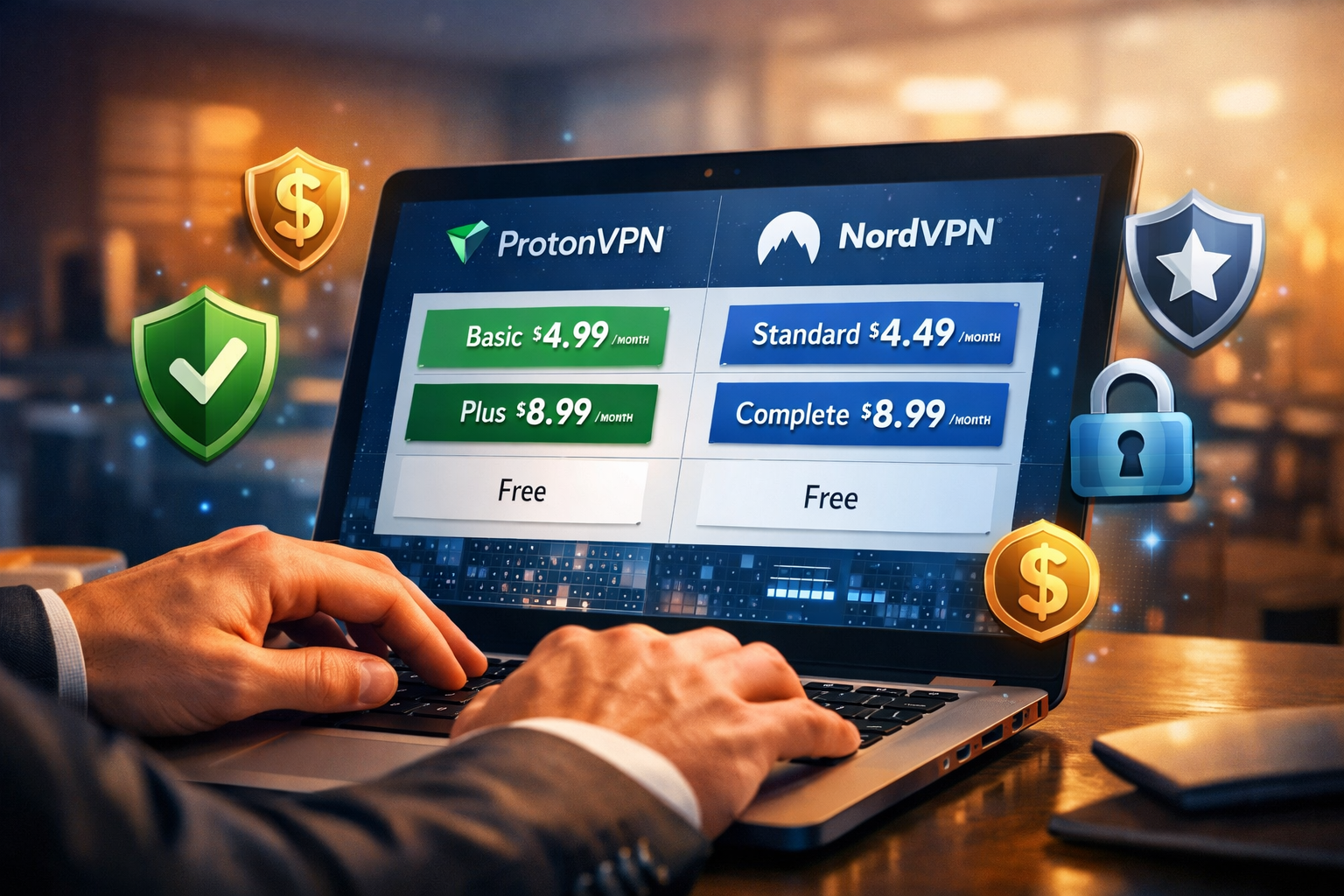
| 1-year | ~$4.99/mo | ~$4.49/mo |
| 2-year | ~$3.99/mo | ~$3.39/mo |
| Business (per user) | ~$7.99/mo | ~$7.99/mo |
ProtonVPN’s paid plans include access to Proton Mail, Proton Drive, and Proton Calendar at higher tiers. If you already use or want those tools, the bundle pricing makes ProtonVPN significantly better value.
NordVPN’s add-ons (Threat Protection, dedicated IP, meshnet) are priced separately, which can push the effective cost up.
Choose ProtonVPN if you want a privacy-focused suite of tools under one account. The Proton ecosystem is real-world protection for your entire digital footprint, not just your VPN traffic.
Choose NordVPN if you only need a VPN and want the lowest per-month cost on a two-year plan.
Have Either Provider Had Security Incidents?
Yes, and you should know about both before deciding.
NordVPN’s 2018 server breach: A third-party data center provider in Finland had an unsecured remote management system that an attacker accessed. NordVPN’s own systems were not directly compromised, and no user credentials were exposed because of the no-logs policy. But the incident was not disclosed publicly until 2019, which raised transparency concerns. NordVPN has since moved to RAM-only servers and completed multiple independent audits.
ProtonVPN’s track record: No confirmed breaches as of 2026. ProtonVPN has complied with Swiss legal orders in criminal investigations (as required by law), but the data provided was limited to IP addresses and connection timestamps because that is all their logs contain. This is actually the system working as intended, not a failure.
What this means for you: NordVPN’s incident was handled poorly in terms of disclosure timing. Their technical response since then has been strong. ProtonVPN’s legal compliance cases show that even a privacy-first provider will respond to valid legal orders. The difference is that their minimal logging limits what they can actually hand over.
ProtonVPN vs NordVPN for Business Use
For SMB owners with 1 to 250 employees, both providers have business-grade products, but they serve slightly different needs.
NordVPN Teams (now NordLayer): Rebranded as NordLayer, this product is built specifically for business. It includes centralized user management, activity monitoring (for compliance), gateway controls, and integration with identity providers like Google Workspace and Azure AD. It is SMB-ready out of the box and easier to deploy for non-technical teams.
ProtonVPN for Business: Stronger on privacy defaults. Ideal for businesses in regulated industries (legal, healthcare, finance) where data confidentiality is critical. Less polished on the admin dashboard side compared to NordLayer, but the underlying security is tested and verified.
Decision rule:
- Choose NordLayer/NordVPN if you need centralized management, SSO integration, and a product your IT team can deploy quickly.
- Choose ProtonVPN for Business if you handle sensitive client data and need the strongest possible privacy architecture with open-source verification.
Which VPN Is Better for Streaming?
NordVPN is better for streaming. It unblocks Netflix, BBC iPlayer, Disney+, Hulu, and most major platforms more consistently than ProtonVPN based on independent testing in 2025.
ProtonVPN unblocks many streaming services too, but its server selection for streaming is smaller and some platforms detect and block ProtonVPN servers more frequently.
Streaming performance summary:
- Netflix US: Both work, NordVPN more reliably
- BBC iPlayer: NordVPN more consistent
- Disney+: Both work
- Hulu: NordVPN edges ahead
- Amazon Prime Video: Both work
If streaming is your main use case, NordVPN is the clearer choice. But if you are using a VPN primarily for privacy and streaming is secondary, ProtonVPN handles it well enough.
FAQ: ProtonVPN vs NordVPN
Q: Is ProtonVPN actually more private than NordVPN? Yes, in most measurable ways. ProtonVPN’s open-source apps, Swiss jurisdiction, and minimal logging give it a verifiable privacy edge. NordVPN is still a strong privacy provider, but you have to take more on trust.
Q: Which VPN is faster for everyday use? NordVPN is faster on average, particularly with NordLynx. For most users, the difference is noticeable during large downloads or 4K streaming, but not during regular browsing.
Q: Can I use ProtonVPN for free? Yes. ProtonVPN’s free plan offers unlimited data with no ads and no logs, limited to servers in three countries. It is the most credible free VPN plan available in 2026.
Q: Does NordVPN keep logs? NordVPN’s no-logs policy has been audited by Deloitte. Their RAM-only server infrastructure means no data is written to disk. The 2018 incident did not expose user logs because there were none to expose.
Q: Which is better for China or censored regions? ProtonVPN’s Stealth protocol is more reliable for bypassing deep packet inspection in countries like China. NordVPN’s obfuscated servers work too, but require manual server selection.
Q: Are both VPNs safe for banking and financial transactions? Yes. Both use AES-256 or ChaCha20 encryption, which is the same standard used by financial institutions. Either is a solid first line of defense on public Wi-Fi.
Q: Which VPN has better customer support? NordVPN offers 24/7 live chat with faster response times. ProtonVPN’s support is primarily email-based with a strong knowledge base, but live chat is limited to paid tiers.
Q: Can I use either VPN on multiple devices? ProtonVPN allows up to 10 simultaneous connections on paid plans. NordVPN allows 10 connections as well. Both cover the typical household or small team.
Q: Which is better for torrenting? Both support P2P on dedicated servers. NordVPN’s SOCKS5 proxy is a useful extra for torrent clients. ProtonVPN’s no-logs policy and Swiss jurisdiction make it slightly more privacy-protective for P2P use.
Q: Is there a big price difference? On two-year plans, NordVPN is roughly $0.60 cheaper per month. ProtonVPN’s bundle with Proton Mail and Drive makes it better value if you use those services.
Conclusion: Which VPN Should You Choose?
The protonvpn vs nordvpn decision comes down to one question: what matters more to you, maximum verifiable privacy or maximum speed and convenience?
Choose ProtonVPN if:
- Privacy is non-negotiable and you want open-source, audited software
- You operate in a regulated industry or handle sensitive client data
- You want a free VPN that is actually trustworthy
- You travel to countries with heavy internet censorship
- You want the Proton ecosystem (Mail, Drive, Calendar) bundled in
Choose NordVPN if:
- Speed and streaming performance are top priorities
- You need a business VPN with centralized management (NordLayer)
- You want the lowest cost on a long-term plan
- You need a large, reliable server network across many countries
Both are tested and verified providers. Neither is a bad choice. But if you are an SMB owner handling client data, or a privacy-conscious individual who wants to cut through the noise and pick the option with the most accountability built in, ProtonVPN is the one I recommend.
Start with ProtonVPN’s free plan today. Test it for a week. If speed becomes an issue, NordVPN’s 30-day money-back guarantee makes it easy to compare without financial risk. Security that actually works is the kind you will actually use, so pick the one that fits your workflow and stick with it.
References
- Proton AG. (2023). ProtonVPN Security Audit by Securitum. proton.me/blog
- NordVPN. (2023). NordVPN No-Logs Audit by Deloitte. nordvpn.com/blog
- Cimpanu, C. (2019). NordVPN discloses security breach. ZDNet. zdnet.com
- PCMag. (2024). NordVPN Review. pcmag.com
- Tom’s Guide. (2025). ProtonVPN Review. tomsguide.com
- ProtonVPN GitHub. (2024). Open-source VPN apps. github.com/ProtonVPN