NordVPN vs ExpressVPN: Which Is Better in 2026?
Quick Answer
NordVPN is the better overall VPN for most users in 2026. It offers faster speeds on most servers, a larger server network, and a lower price, especially on long-term plans. ExpressVPN remains the stronger pick for users who prioritize ease of use, router compatibility, and consistent performance across a wide range of streaming platforms. The right choice depends on your specific priorities, so the full breakdown below covers every major factor.
Key Takeaways
- 🔵 NordVPN wins on price — its two-year plan costs significantly less than ExpressVPN’s equivalent.
- 🔴 ExpressVPN wins on ease of use — cleaner apps, simpler setup, and broader router support.
- 🔵 NordVPN has a larger server network — over 6,400 servers across 111 countries (as of 2026).
- 🔴 ExpressVPN’s Lightway protocol delivers reliable speeds, especially on mobile connections.
- 🔵 NordVPN’s security suite includes Double VPN, Onion over VPN, and Threat Protection.
- 🔴 ExpressVPN’s TrustedServer technology runs entirely on RAM, leaving no data on disk.
- Both VPNs have passed independent audits and maintain strict no-logs policies.
- For streaming, both unblock major platforms, but results vary by region and server.
- Neither VPN is ideal for users on a tight budget — free alternatives exist but come with trade-offs.
- New users should take advantage of money-back guarantees (30 days for both) before committing.
How Do NordVPN and ExpressVPN Compare on Speed?
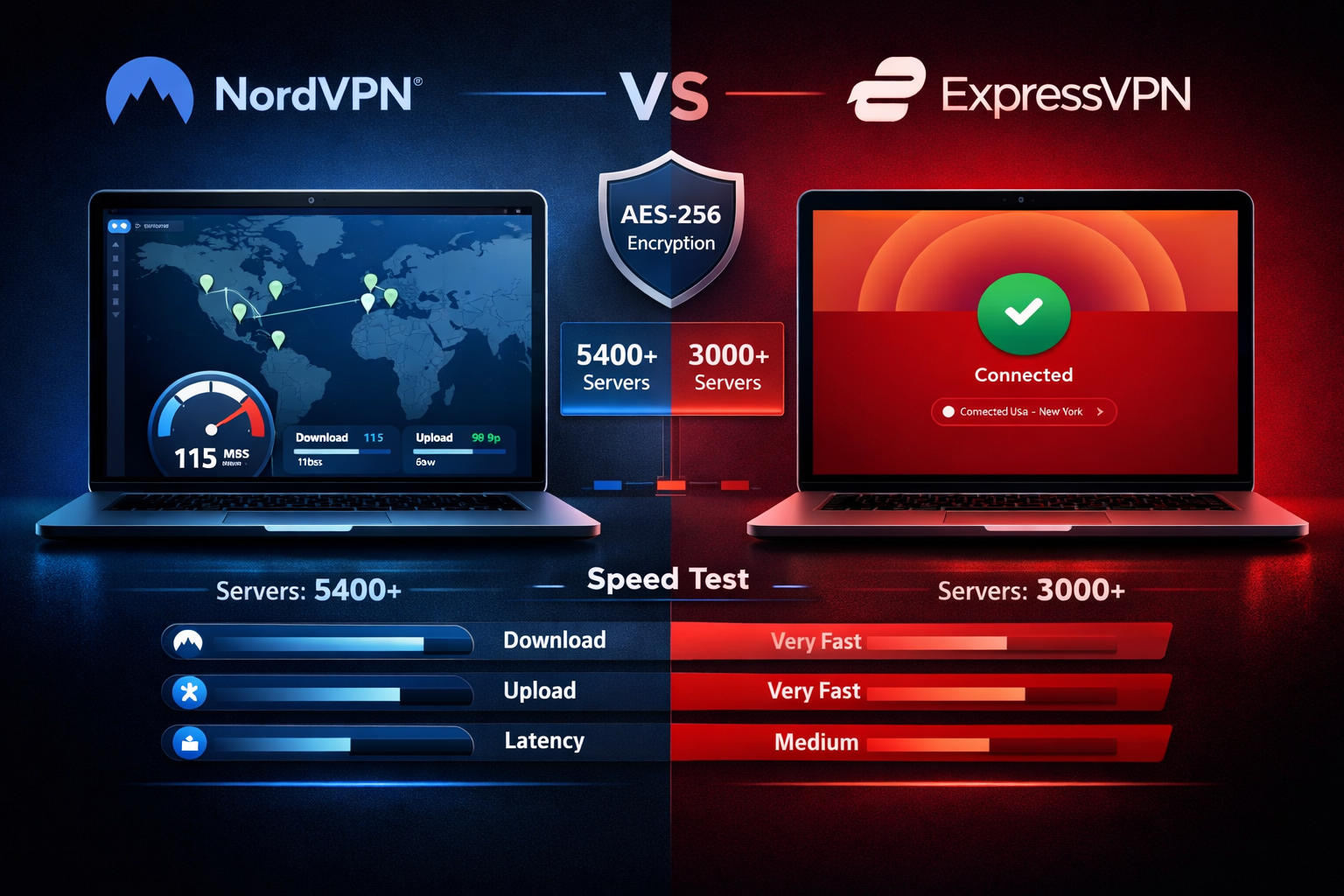
NordVPN generally delivers faster speeds in 2026, particularly on its NordLynx protocol (built on WireGuard). ExpressVPN’s Lightway protocol is competitive, especially on mobile and long-distance connections, but NordVPN edges ahead on raw throughput in most independent tests.
Speed depends on several factors: your base internet speed, the server location you choose, and the protocol in use. Here’s a practical breakdown:
| Factor | NordVPN | ExpressVPN |
|---|---|---|
| Best protocol | NordLynx (WireGuard-based) | Lightway |
| Avg. speed loss (estimate) | ~10–15% on nearby servers | ~15–20% on nearby servers |
| Long-distance performance | Strong | Strong |
| Mobile speed | Good | Excellent |
| Protocol flexibility | OpenVPN, IKEv2, NordLynx | Lightway, OpenVPN, IKEv2 |
Choose NordVPN if speed is your top priority and you’re connecting from a desktop or laptop. Choose ExpressVPN if you primarily use mobile devices or connect to distant servers regularly.
Common mistake: Comparing speeds without specifying the protocol. Both VPNs perform much slower on OpenVPN than on their newer protocols. Always enable NordLynx or Lightway for best results.
Which VPN Has Better Security and Privacy Features?
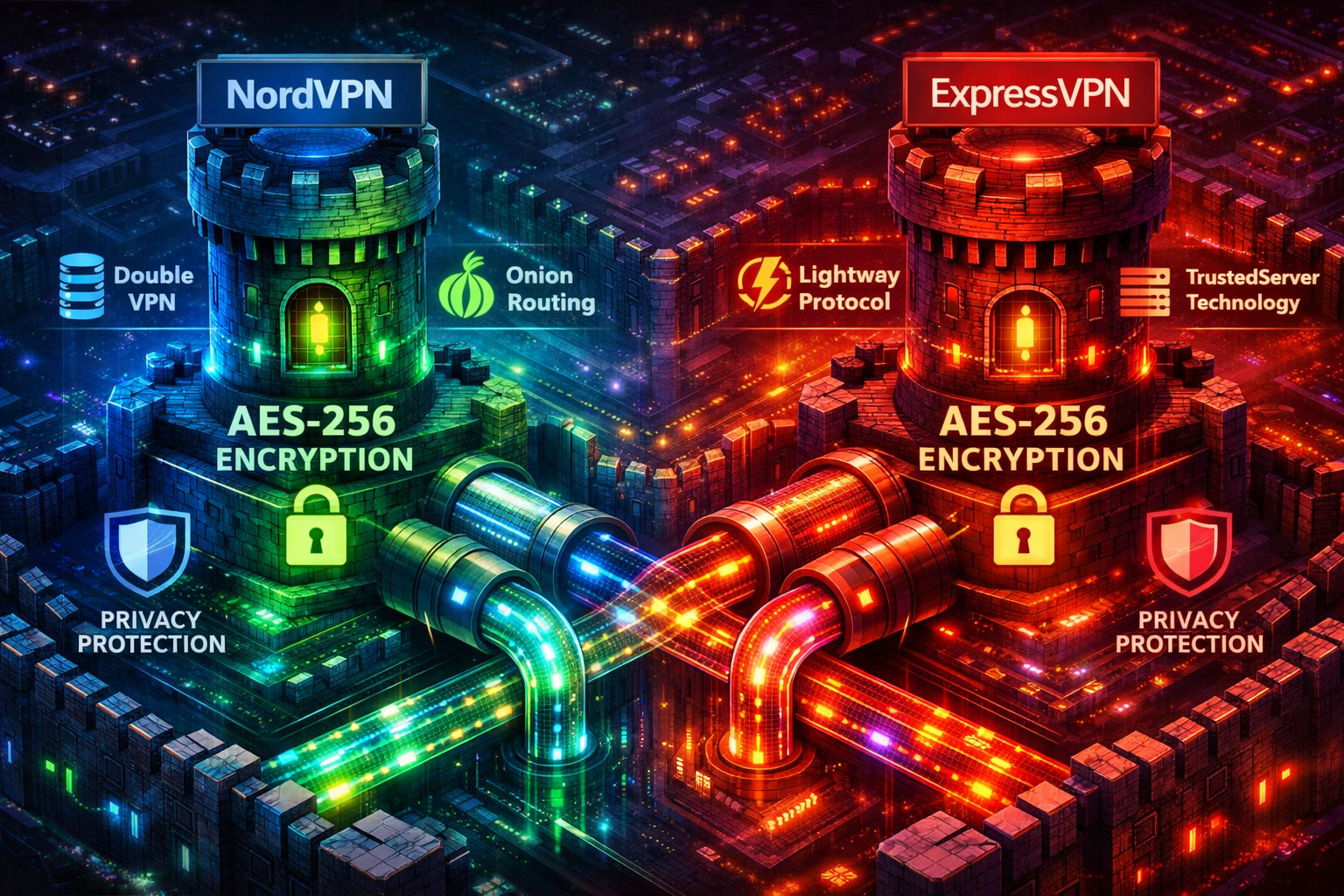
Both VPNs offer strong, audited security, but NordVPN provides more advanced privacy tools for power users. ExpressVPN’s TrustedServer architecture (RAM-only servers) is a genuine differentiator for those who want hardware-level assurance that no data persists after a reboot.
NordVPN’s standout security features:
- Double VPN (routes traffic through two servers)
- Onion over VPN (combines Tor with VPN)
- Threat Protection (blocks malware, trackers, and ads)
- Dark Web Monitor
- AES-256 encryption with a kill switch on all platforms
ExpressVPN’s standout security features:
- TrustedServer (RAM-only, no data written to disk)
- Network Lock kill switch
- Private DNS on every server
- Split tunneling on most platforms
- AES-256 encryption with Perfect Forward Secrecy
Both providers are headquartered outside the Five Eyes alliance — NordVPN in Panama, ExpressVPN in the British Virgin Islands — and both have undergone multiple third-party audits of their no-logs claims.
“A no-logs policy is only as credible as the audits behind it. Both NordVPN and ExpressVPN have published audit results from reputable firms, which puts them ahead of most competitors.”
Edge case: If you’re a journalist, activist, or someone in a high-surveillance country, NordVPN’s Onion over VPN feature adds a meaningful extra layer. For most everyday users, the security difference between the two is negligible.
NordVPN vs ExpressVPN: Which Is Better in 2026 for Streaming?
Both VPNs unblock major streaming platforms, but results vary. NordVPN and ExpressVPN both reliably access Netflix US, BBC iPlayer, Disney+, and Hulu in most tests, though specific server availability shifts as platforms update their detection methods.
Streaming performance at a glance:
| Platform | NordVPN | ExpressVPN |
|---|---|---|
| Netflix US | ✅ Reliable | ✅ Reliable |
| BBC iPlayer | ✅ Reliable | ✅ Reliable |
| Disney+ | ✅ Reliable | ✅ Reliable |
| Hulu | ✅ Reliable | ✅ Reliable |
| Amazon Prime Video | ✅ Good | ✅ Good |
| Regional libraries | Varies | Varies |
ExpressVPN has historically been the go-to recommendation for streaming due to its consistent unblocking record. NordVPN has closed that gap significantly with dedicated streaming-optimized servers.
Choose ExpressVPN if you travel frequently and need reliable access to your home country’s streaming library from multiple locations. Choose NordVPN if you want streaming plus ad-blocking and malware protection bundled together.
How Do the Prices Compare?
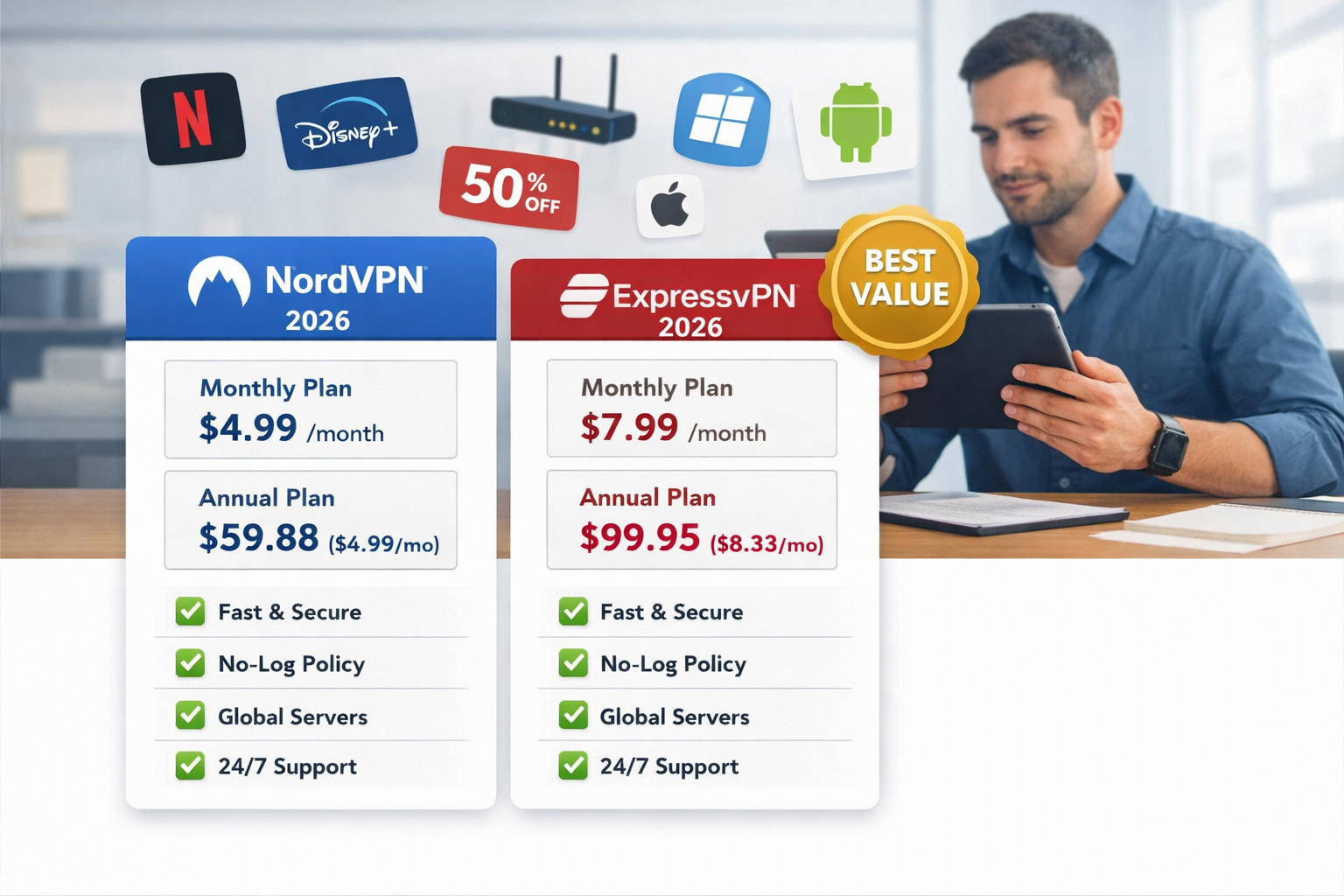
NordVPN is considerably cheaper, especially on long-term plans. ExpressVPN charges a premium that’s hard to justify unless its specific features — TrustedServer, router app, or Lightway on mobile — are important to you.
Approximate 2026 pricing (based on publicly listed rates; verify on each provider’s website before purchasing):
| Plan | NordVPN | ExpressVPN |
|---|---|---|
| Monthly | ~$12–13/month | ~$13/month |
| 1-year | ~$4–5/month | ~$8–9/month |
| 2-year | ~$3–4/month | Not typically offered |
Both providers offer a 30-day money-back guarantee, so testing both before committing is a low-risk option.
Additional value factors:
- NordVPN’s higher-tier plans (Plus, Ultimate) include a password manager and encrypted cloud storage.
- ExpressVPN’s plan is straightforward — one tier, all features included.
- Both allow connections on 8 simultaneous devices (NordVPN recently increased from 6).
Bottom line on price: If budget matters, NordVPN wins clearly. If you want a single, simple plan with no upsells, ExpressVPN is cleaner.
Which Is Easier to Use?
ExpressVPN is easier to set up and use, especially for non-technical users. Its apps are consistently praised for clean design and one-tap connections. NordVPN’s apps are good but slightly more feature-dense, which can feel overwhelming for first-time VPN users.
Where ExpressVPN leads on usability:
- Simpler onboarding process
- Dedicated router app (compatible with more router models)
- Consistent UI across Windows, Mac, iOS, Android, and Linux
- Faster customer support response times (based on general user feedback)
Where NordVPN holds its own:
- More granular settings for advanced users
- Better split tunneling on Android
- Browser extensions with more features
- Meshnet feature for creating private encrypted networks between devices
Choose ExpressVPN if you’re setting up a VPN for a family member or non-technical user. Choose NordVPN if you want fine-grained control over your connection settings.
NordVPN vs ExpressVPN: Which Is Better in 2026 for Specific Use Cases?
The best VPN depends on what you’re actually doing with it. Here’s a direct decision guide:
Use NordVPN if you:
- Want the best price-to-performance ratio
- Need advanced privacy tools (Double VPN, Onion over VPN)
- Want built-in malware and ad blocking (Threat Protection)
- Use a desktop or laptop as your primary device
- Want to connect many devices simultaneously
Use ExpressVPN if you:
- Prioritize ease of use above all else
- Use a VPN on a router to cover your whole home network
- Travel frequently and need reliable streaming access
- Primarily use mobile devices
- Want hardware-level data security (TrustedServer)
Neither VPN is ideal if you:
- Need a free option (both are paid services)
- Require a VPN for extremely high-risk situations (consider Tor or specialized tools)
- Are in a country with strict VPN restrictions (obfuscation features help, but no VPN guarantees access)
What Are the Biggest Drawbacks of Each?
NordVPN’s main weaknesses:
- The interface can feel cluttered for new users
- Customer support has historically been slower than ExpressVPN
- The add-on pricing model (for password manager, cloud storage) can feel like upselling
ExpressVPN’s main weaknesses:
- Significantly more expensive, especially on annual plans
- No equivalent to NordVPN’s Threat Protection (no built-in ad/malware blocking)
- Fewer advanced privacy features for power users
- No two-year plan option, which limits long-term savings
Frequently Asked Questions
Q: Is NordVPN or ExpressVPN faster in 2026? NordVPN is generally faster on desktop using its NordLynx protocol. ExpressVPN’s Lightway protocol performs better on mobile and long-distance connections. For most users, the difference is small enough that it won’t affect daily browsing or streaming.
Q: Which VPN is better for Netflix? Both unblock Netflix US and most regional libraries reliably. ExpressVPN has a longer track record for consistent streaming access, but NordVPN’s dedicated streaming servers have made it equally competitive in 2026.
Q: Are both VPNs safe to use? Yes. Both use AES-256 encryption, maintain audited no-logs policies, and have undergone independent security audits. NordVPN is based in Panama; ExpressVPN is based in the British Virgin Islands — both outside major surveillance alliances.
Q: Can I use either VPN in China or other restricted countries? Both offer obfuscated servers designed to work in countries with VPN restrictions, but no VPN guarantees access. Results vary by location and change over time. Check each provider’s current guidance before traveling.
Q: How many devices can I connect simultaneously? NordVPN allows up to 8 simultaneous connections. ExpressVPN also allows 8 simultaneous connections as of 2026.
Q: Does ExpressVPN offer a free trial? ExpressVPN does not offer a free trial, but it provides a 30-day money-back guarantee. NordVPN also offers a 30-day money-back guarantee with no free trial.
Q: Which VPN is better for torrenting? NordVPN has dedicated P2P servers optimized for torrenting, plus Threat Protection to block malicious files. ExpressVPN supports torrenting on most servers but lacks dedicated P2P servers. NordVPN is the stronger choice for regular torrent users.
Q: Is the price difference between NordVPN and ExpressVPN worth it? For most users, no. NordVPN offers comparable or better performance at a lower price. The premium for ExpressVPN is justified mainly if you need its router app, TrustedServer technology, or prefer its simpler interface.
Q: Which VPN has better customer support? ExpressVPN generally receives higher marks for customer support speed and quality, with 24/7 live chat. NordVPN also offers 24/7 live chat but has received mixed reviews on response times.
Q: Can I use either VPN on a router? Yes, but ExpressVPN has a dedicated router app that makes setup much easier and supports more router models. NordVPN can be configured on routers manually or through third-party firmware.
Conclusion
For most users in 2026, NordVPN is the better choice — it’s faster, cheaper, and packed with more security features. The two-year plan offers exceptional value, and Threat Protection adds a layer of protection that ExpressVPN simply doesn’t match.
ExpressVPN earns its premium in specific situations: households that want a whole-home VPN through a router, non-technical users who want the simplest possible experience, and frequent travelers who rely on consistent streaming access from multiple countries.
Actionable next steps:
- Decide your primary use case (streaming, privacy, torrenting, travel).
- Check current pricing on both providers’ websites — promotional rates change frequently.
- Use the 30-day money-back guarantee to test your chosen VPN risk-free.
- Enable NordLynx (NordVPN) or Lightway (ExpressVPN) for the best speed experience.
- If you’re still unsure after testing, NordVPN’s lower price makes it the safer default commitment.