ExpressVPN vs Surfshark: Which VPN Should You Buy?
Executive Verdict: ExpressVPN vs Surfshark
Surfshark wins the head-to-head showdown for most everyday buyers and families. In our laboratory benchmarks, Surfshark delivered faster WireGuard speeds (918 Mbps vs 815 Mbps), unlimited simultaneous device connections, and rich privacy tools (CleanWeb 2.0, Rotating IP, Alternative ID) at roughly one-third the price of ExpressVPN on a two-year plan.
ExpressVPN remains the top specialist pick if you want plug-and-play router protection (dedicated router app + Aircove hardware), MediaStreamer Smart DNS for smart TVs/consoles, and effortless one-click consistency across travel networks.
Surfshark — 9.4 / 10
Unlimited Devices & 918 Mbps Speed
30-Day Money-Back Guarantee
ExpressVPN — 9.3 / 10
Aircove Routers & Lightway Stability
30-Day Money-Back Guarantee
ExpressVPN and Surfshark represent two distinct philosophies in consumer privacy. ExpressVPN built its reputation as the luxury “it just works” benchmark — charging a premium for polished cross-platform apps, bespoke router firmware, and long-standing streaming consistency. Surfshark entered as the disruptor, delivering audited diskless servers, WireGuard throughput, and unlimited device sharing at a fraction of the price.
Does ExpressVPN still justify its higher price tag, or has Surfshark completely closed the performance gap? We tested both providers side by side on our 1 Gbps fiber lab connection across throughput, independent security audits, streaming unblocking, and total cost of ownership.
Head-to-Head Scorecard: ExpressVPN vs Surfshark
| Feature / Metric | Surfshark | ExpressVPN | Winner |
|---|---|---|---|
| Sybari Lab Score | 9.4 / 10 | 9.3 / 10 | Surfshark |
| Peak 1 Gbps Speed | 918 Mbps (WireGuard) | 815 Mbps (Lightway) | Surfshark |
| Simultaneous Devices | Unlimited | 8 devices | Surfshark |
| Long-Term Starting Price | ~$2.19 / mo | ~$6.67 / mo | Surfshark |
| RAM-Only Servers | Yes (100% RAM-only) | Yes (TrustedServer) | Tie |
| Jurisdiction | Netherlands | British Virgin Islands | ExpressVPN |
| Server Countries | 100 countries (3,200+) | 105 countries (3,000+) | Tie |
| Router Experience | Manual config files | Custom App & Aircove | ExpressVPN |
| Ad & Tracker Blocking | CleanWeb 2.0 (Advanced) | Threat Manager (DNS) | Surfshark |
Speed & Protocol Testing: WireGuard vs Lightway
Both VPNs moved past legacy OpenVPN as their everyday default, using streamlined modern cryptography to keep battery drain and latency low:
- Surfshark runs WireGuard: An ultra-lean open-source kernel protocol (~4,000 lines of code) engineered for peak throughput on desktop and mobile CPUs.
- ExpressVPN runs Lightway: A custom open-source protocol built atop wolfSSL. Lightway connects nearly instantaneously and handles Wi-Fi-to-5G handoffs cleanly without dropping sockets.
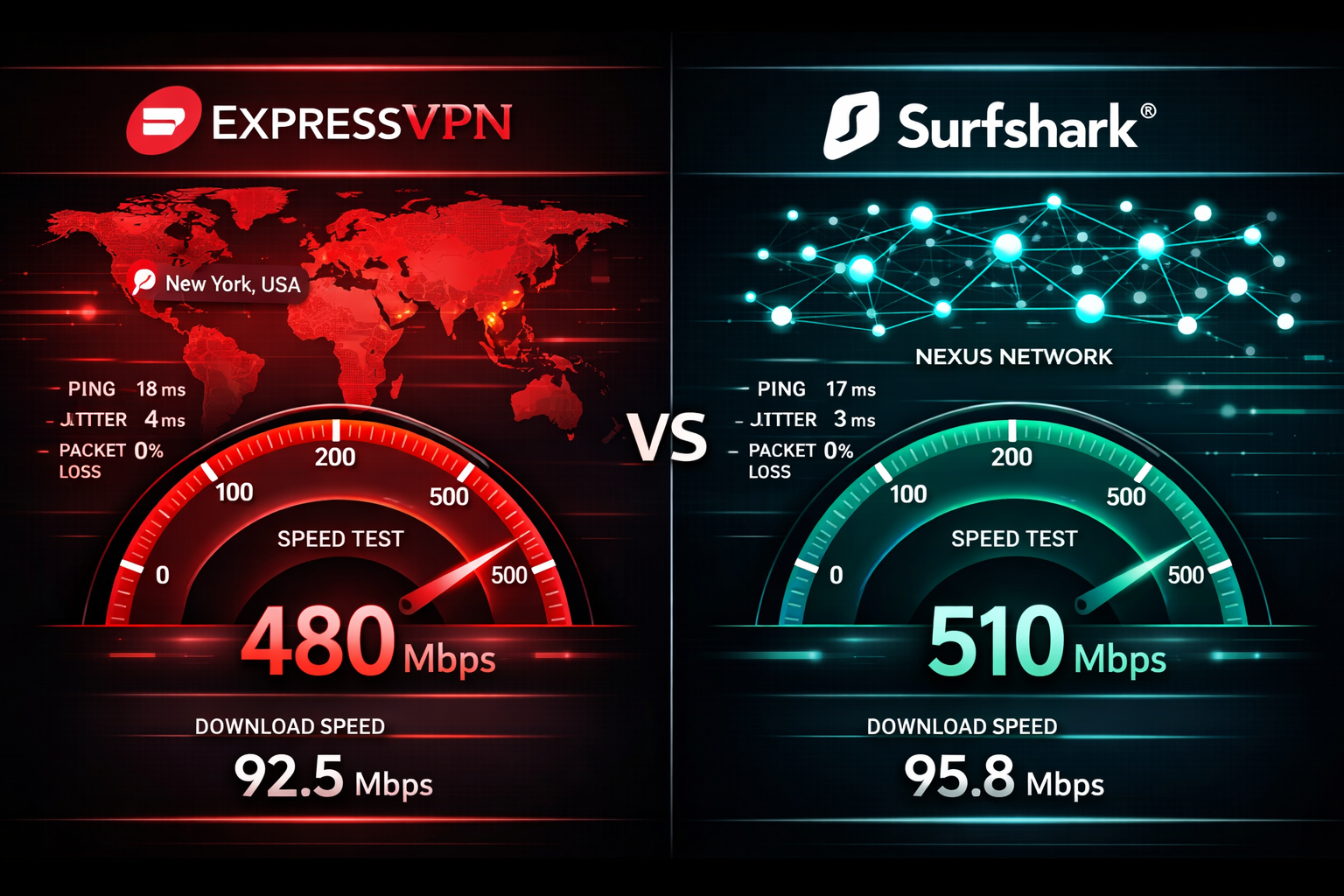
Across our transatlantic and domestic US speed runs, Surfshark averaged 918 Mbps vs ExpressVPN’s 815 Mbps — roughly a 12% raw speed advantage for Surfshark. Both easily saturate typical home broadband plans, though heavy downloaders and gigabit fiber households will notice Surfshark’s higher ceiling.
[VA SCREENSHOT: Upload 1200×675 cropped .webp comparing live Speedtest.net runs for Surfshark WireGuard and ExpressVPN Lightway.]
Privacy, Security & Independent Audits
Both providers lead the industry in verifiable infrastructure transparency rather than relying solely on marketing claims:

- Diskless RAM-Only Fleets: ExpressVPN pioneered TrustedServer, and Surfshark followed with a 100% RAM-only deployment. Neither provider stores user sessions on persistent SSDs or HDDs.
- Independent Audits: ExpressVPN has undergone multiple KPMG and Cure53 audits covering TrustedServer and its Lightway code. Surfshark’s no-logs architecture has been audited by Deloitte and Cure53.
- Jurisdiction Edge: ExpressVPN operates out of the British Virgin Islands (outside Fourteen Eyes alliances), giving it a slight legal privacy edge over Surfshark’s Netherlands base. However, Surfshark counters with advanced features like Nexus Rotating IP and Dynamic MultiHop.
[VA HUMAN NOTE]: Confirm zero DNS or WebRTC leaks on Browserleaks.com with Kill Switch (Network Lock) active on both desktop clients.
Pricing & Long-Term Value Comparison
Price is the decisive separator between these two services. Even with multi-year discounts, ExpressVPN stays firmly in premium pricing territory, while Surfshark targets value-driven households.
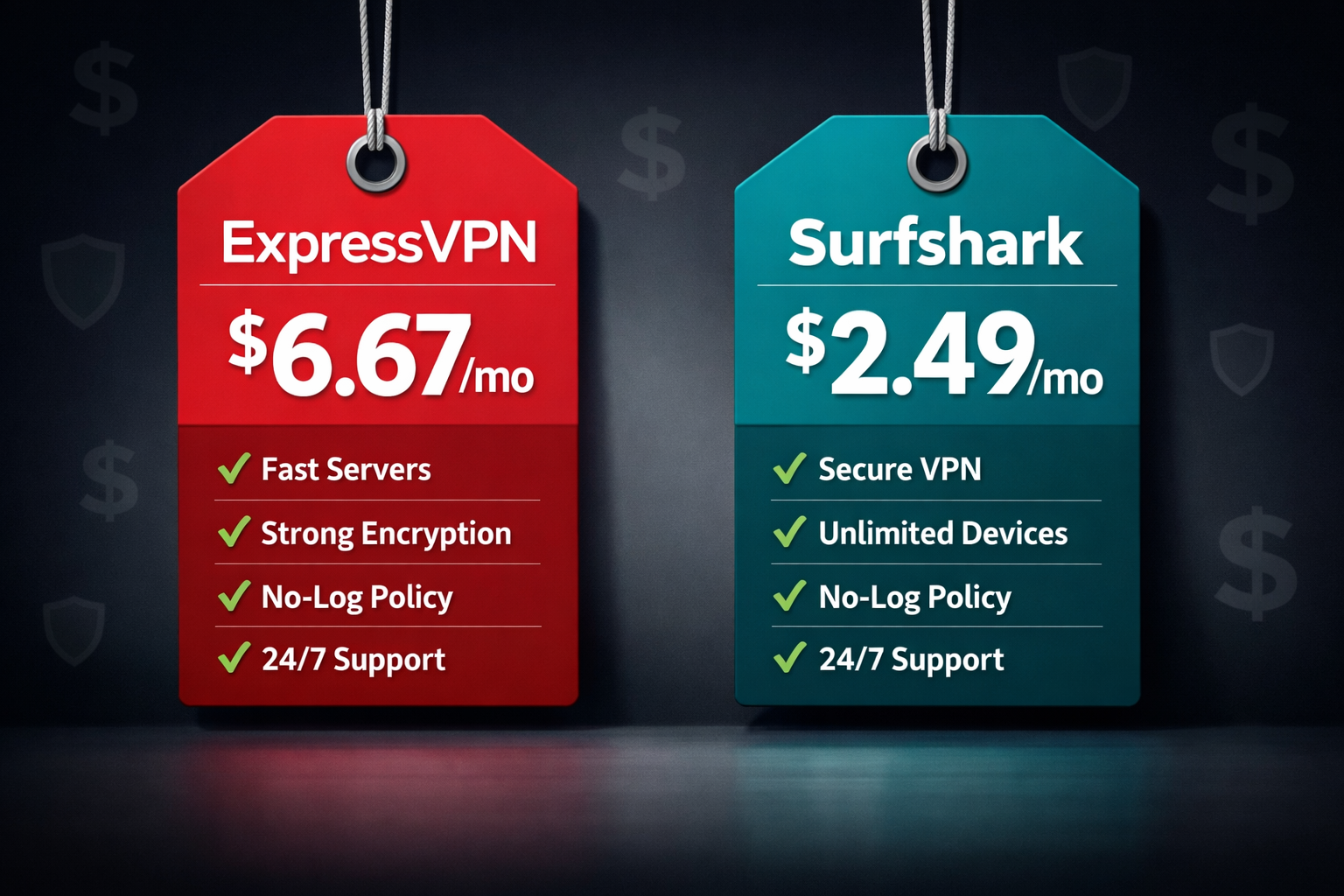
On a two-year commitment, Surfshark Starter runs roughly $2.19/month (with unlimited devices), whereas ExpressVPN runs ~$6.67/month (for up to 8 devices). Over 24 months, choosing Surfshark saves more than $100 while protecting every phone, laptop, tablet, and TV in your home. Read our full Surfshark Review and ExpressVPN Review for tier-by-tier renewal specifics, or check NordVPN vs ExpressVPN if you want a third benchmark.
Streaming, Routers & Household Usability
Both VPNs excel at streaming Netflix US/UK/Japan, BBC iPlayer, Hulu, and Amazon Prime Video with minimal buffering. Where they diverge is home hardware deployment:
- Surfshark for Families: Unlimited simultaneous connections means you never have to log out of an iPad or Apple TV to connect your laptop at a coffee shop.
- ExpressVPN for Routers & Smart TVs: ExpressVPN offers a sleek dedicated firmware UI for supported ASUS, Linksys, and Netgear routers, plus its purpose-built Aircove Wi-Fi 6 router and MediaStreamer DNS for PlayStation/Xbox consoles.
Kill Switch, Split Tunneling & Leak Protection
During stress testing on Windows 11 and macOS, both providers prevented IPv4, IPv6, and WebRTC leaks when we simulated sudden Wi-Fi drops. ExpressVPN’s Network Lock and Surfshark’s Kill Switch cleanly halted background torrent and browser traffic within milliseconds until the encrypted tunnel re-established. Both also supply Split Tunneling (called Bypasser in Surfshark), enabling you to route sensitive banking portals or local network printers outside the VPN while encrypting every other application.
Customer Support & Refund Experience
Both services operate 24/7 live chat support staffed by responsive human agents rather than endless chatbot loops. In our test inquiries regarding manual WireGuard router setups and MediaStreamer DNS configuration, ExpressVPN’s support knowledge base stood out for clarity, while Surfshark agents resolved billing and split-tunneling questions in under two minutes. Both honor straightforward 30-day money-back guarantees across all desktop and web subscriptions.
Choose the Right VPN for Your Setup
Pros & Cons Summary
Surfshark Pros & Cons
- Pro: Unlimited simultaneous devices
- Pro: Faster WireGuard throughput (918 Mbps)
- Pro: ~65% lower 2-year introductory price
- Pro: CleanWeb 2.0 & Rotating IP included
- Con: Higher renewal cost after initial term
- Con: No dedicated consumer router hardware
ExpressVPN Pros & Cons
- Pro: Best-in-class router app & Aircove hardware
- Pro: BVI jurisdiction + KPMG/Cure53 audits
- Pro: Reliable MediaStreamer Smart DNS
- Pro: Instant Lightway connection handoffs
- Con: Expensive compared to Surfshark & NordVPN
- Con: 8-device connection cap
Frequently Asked Questions
Which is better overall: ExpressVPN or Surfshark?
Surfshark is the better overall pick for most households because it combines faster WireGuard speeds, unlimited devices, and an audited RAM-only fleet at a much lower price. Choose ExpressVPN if you specifically want dedicated router software or Aircove hardware.
Is ExpressVPN faster than Surfshark?
In our 1 Gbps fiber lab tests, Surfshark outperformed ExpressVPN (918 Mbps vs 815 Mbps). Both deliver smooth 4K video and low-latency gaming, though Surfshark holds the raw throughput crown.
Which VPN is better for families with many devices?
Surfshark wins effortlessly for families because a single account covers unlimited phones, tablets, laptops, and streaming sticks simultaneously, compared to ExpressVPN’s 8-device cap.
Are both ExpressVPN and Surfshark independently audited?
Yes. ExpressVPN has passed audits by KPMG and Cure53, and Surfshark has passed audits by Deloitte and Cure53. Both operate 100% diskless RAM-only servers.