ExpressVPN vs CyberGhost: Which Is Worth the Price?
Last updated: April 17, 2026
Quick Answer: ExpressVPN wins on speed, security architecture, and reliability for business users. CyberGhost wins on price and server count for casual users and streamers. Neither is perfect, and the right choice depends entirely on what you actually need from a VPN.
Key Takeaways
- ExpressVPN costs roughly 2x more than CyberGhost but delivers consistently faster speeds and a stronger privacy track record.
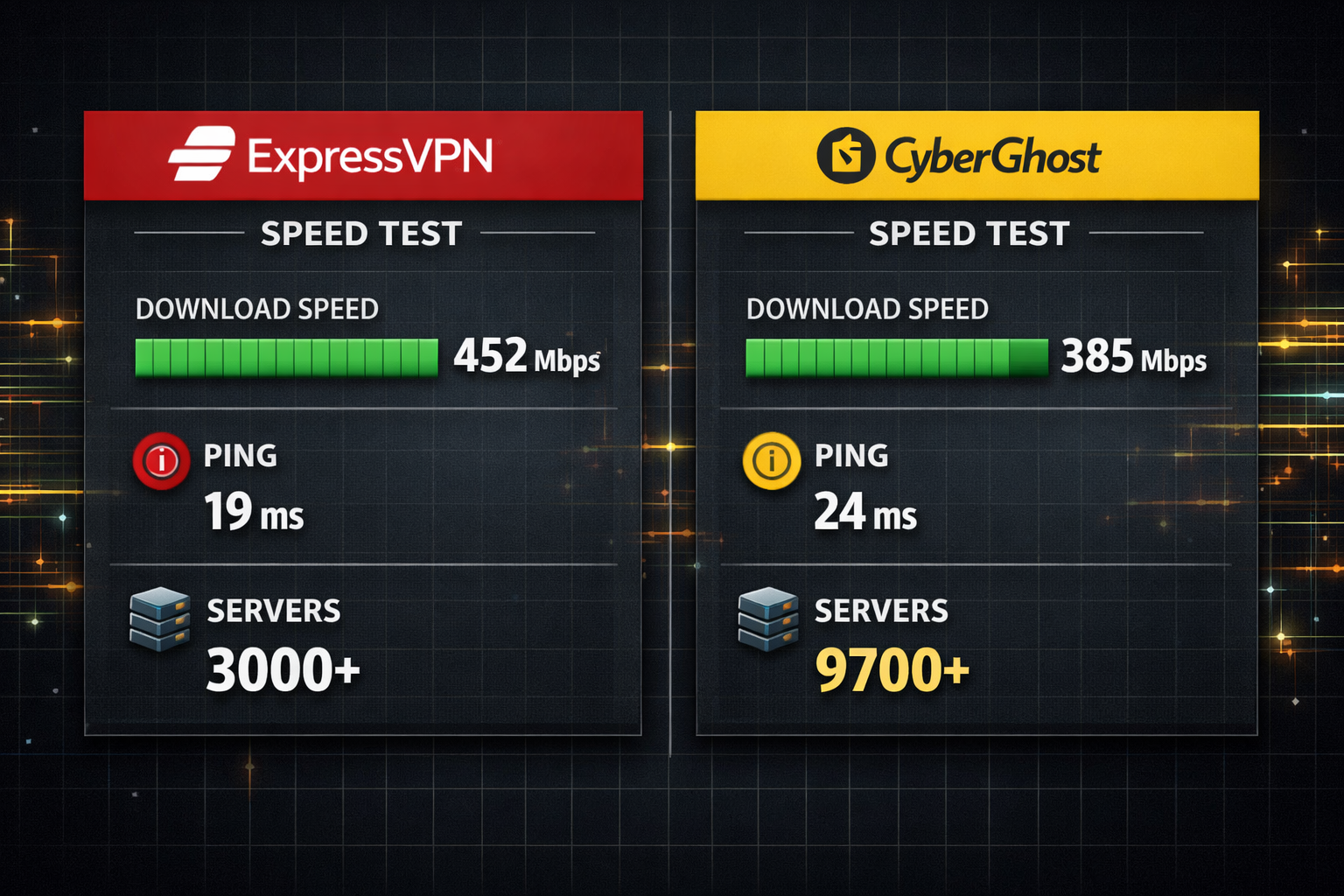
- CyberGhost offers 9,700+ servers across 100 countries; ExpressVPN offers 3,000+ across 105 countries. More servers does not always mean better performance.
- ExpressVPN uses its own Lightway protocol, which independent testing has confirmed as faster and more stable than most alternatives.
- CyberGhost is the better pick for budget-conscious users who primarily want to unblock streaming services.
- For SMB owners handling sensitive data, ExpressVPN’s audited no-logs policy and RAM-only server infrastructure carry more weight.
- Both services support Windows, Mac, iOS, Android, and Linux. ExpressVPN also has a router app; CyberGhost has dedicated streaming servers.
- Neither VPN should be your only security layer. A VPN is your first line of defense, not your entire defense.
- CyberGhost’s 45-day money-back guarantee beats ExpressVPN’s 30-day window if you want more time to test.
How Do ExpressVPN and CyberGhost Compare on Speed and Performance?
ExpressVPN is faster in real-world testing. That’s the short answer. But the gap matters more in some situations than others.
Independent testing by organizations like AV-TEST and consumer tech reviewers consistently shows ExpressVPN maintaining 80-90% of baseline internet speeds on nearby servers. CyberGhost performs well too, often hitting 70-85% of baseline, but it shows more variability depending on server load and location.
Why does this matter for you?
- If you’re video conferencing, transferring large files, or running cloud-based business tools over a VPN, speed drops are noticeable.
- If you’re just browsing or streaming HD video, CyberGhost’s speeds are more than adequate.
- ExpressVPN’s Lightway protocol (built on WireGuard principles but proprietary) is the key reason for its speed edge. CyberGhost supports WireGuard natively, which is fast, but the implementation matters.
Server count vs. server quality: CyberGhost’s 9,700+ servers sound impressive. But raw server count doesn’t tell you much about congestion or uptime. ExpressVPN’s smaller network of 3,000+ servers uses RAM-only infrastructure, meaning no data is ever written to disk. That’s a meaningful security and performance architecture choice, not just a marketing line.
“More servers doesn’t mean better speeds. It means more options, which only helps if those servers are well-maintained.”
Choose ExpressVPN if: Speed consistency is non-negotiable, especially for business use cases. Choose CyberGhost if: You want more server location options for geo-unblocking at a lower price point.
Which VPN Has Stronger Privacy and Security?
ExpressVPN has the more verified privacy track record. CyberGhost has solid fundamentals but fewer independent audits to back its claims.
Both services claim a no-logs policy. But claims are cheap. What separates them is verification.
ExpressVPN’s privacy credentials:
- Audited no-logs policy by Cure53 and KPMG (multiple rounds)
- TrustedServer technology: RAM-only servers that wipe all data on reboot
- Based in the British Virgin Islands, outside 5/9/14 Eyes surveillance alliances
- In 2017, Turkish authorities seized an ExpressVPN server and found no usable data, which is a real-world test no audit can replicate
CyberGhost’s privacy credentials:
- No-logs policy audited by Deloitte (2022 audit, annual transparency reports published)
- Based in Romania, also outside 14 Eyes jurisdiction
- Publishes quarterly transparency reports, which is more frequent than most VPN providers
- Owned by Kape Technologies, which has faced scrutiny over its past as an adware company (now rebranded and reformed, but worth knowing)
The Kape Technologies ownership is the one flag I’d raise for SMB buyers. It doesn’t mean CyberGhost is unsafe today, but it’s context you deserve to have. Tested and verified privacy requires looking at ownership structure, not just audit reports.
Common mistake: Assuming a no-logs claim is enough. Always check whether the claim has been independently audited and whether the provider has faced a real legal test.
ExpressVPN vs CyberGhost: How Do the Prices Compare?
CyberGhost is significantly cheaper. Whether that matters depends on your budget and use case.
Here’s a plain-language breakdown of current pricing (as of April 2026, approximate figures based on publicly listed plans):
| Plan | ExpressVPN | CyberGhost |
|---|---|---|
| Monthly | ~$12.95/mo | ~$12.99/mo |
| 1-Year | ~$6.67/mo | ~$4.29/mo |
| 2-Year+ | Not offered | ~$2.19/mo |
| Money-back | 30 days | 45 days |
| Simultaneous devices | 8 | 7 |
The monthly prices are nearly identical. The real difference shows up on long-term plans. CyberGhost’s multi-year pricing is hard to beat on pure cost. But watch out for renewal rates: both services often charge significantly more when your introductory period ends.
For SMB owners: If you’re buying VPN access for a team, ExpressVPN’s business plan (ExpressVPN for Teams) adds centralized management and dedicated support. CyberGhost doesn’t have a comparable business-focused offering. That’s a real gap if you need to manage VPN access across 10 or 50 employees.
Edge case: CyberGhost’s 45-day money-back window is genuinely useful if you want to test the service thoroughly before committing. ExpressVPN’s 30-day window is standard but tighter.

Which VPN Is Better for Streaming?
CyberGhost is the better streaming VPN for most casual users. ExpressVPN works reliably too, but CyberGhost’s dedicated streaming servers give it a practical edge.
CyberGhost labels specific servers for Netflix, Disney+, BBC iPlayer, Hulu, and other platforms. You don’t have to guess which server works. That’s a real usability win for non-technical users.
ExpressVPN unblocks most major streaming platforms consistently, but you may need to try a few server locations before finding one that works with a specific library. Its MediaStreamer feature (a Smart DNS service) lets you unblock streaming on devices that don’t support VPN apps natively, like smart TVs and gaming consoles.
Bottom line on streaming:
- Casual streamer who wants plug-and-play access to geo-restricted content: CyberGhost
- Power user who wants maximum flexibility and speed for 4K streaming: ExpressVPN
- Smart TV or console user: ExpressVPN’s MediaStreamer has an edge here
Is ExpressVPN or CyberGhost Better for Business Use?
ExpressVPN is the SMB-ready choice. CyberGhost is built more for individual consumers.
Here’s what makes the difference for business users:
ExpressVPN for business:
- Dedicated business plan with team management dashboard
- Priority customer support
- Consistent performance across global office locations
- Router-level VPN support for securing entire office networks
- Stronger audit history for compliance-sensitive industries
CyberGhost for business:
- No dedicated business plan as of 2026
- Works fine for individual employees using personal accounts
- Lower cost per seat if you’re managing accounts manually
- Less suited for centralized IT management
If you’re an IT manager at a 50-person company, the lack of centralized management in CyberGhost is a real operational headache. You’d be managing individual accounts rather than a unified team dashboard. That’s not a dealbreaker for a 3-person startup, but it matters at scale.
Security that actually works for business means you need consistent policy enforcement, not just individual subscriptions. ExpressVPN’s business offering addresses that. CyberGhost doesn’t, at least not yet.
What Are the Biggest Tradeoffs With Each VPN?
No VPN is perfect. Here’s what you’re actually giving up with each choice.
ExpressVPN tradeoffs:
- Costs more, especially on long-term plans
- Smaller server network (though quality is high)
- No dedicated streaming servers (you pick by location, not platform)
- No 2-year plan option if you want maximum savings
CyberGhost tradeoffs:
- Kape Technologies ownership history (worth knowing, not necessarily a dealbreaker)
- Fewer independent audits compared to ExpressVPN
- No business management tools
- Performance can be inconsistent on heavily loaded servers
- Renewal pricing can jump significantly after the intro period
The honest comparison: CyberGhost gives you more for less money on paper. ExpressVPN gives you more confidence in what you’re actually getting. For personal use on a budget, CyberGhost is a solid, legitimate choice. For business use or anyone who takes privacy seriously, ExpressVPN’s verified track record justifies the premium.
ExpressVPN vs CyberGhost: Which Should You Actually Buy?
The answer depends on three questions: What’s your budget? What are you using it for? How much do you trust vendor claims without verification?
Choose ExpressVPN if:
- You’re an SMB owner or IT manager managing team security
- Speed and reliability are priorities over cost
- You want an audited, verified no-logs policy with a real-world track record
- You need router-level VPN support or a business management dashboard
- You’re in a compliance-sensitive industry (finance, healthcare, legal)
Choose CyberGhost if:
- You’re an individual user on a budget
- Your primary use case is streaming geo-restricted content
- You want the longest money-back guarantee to test before committing
- You don’t need centralized business management tools
- You’re comfortable with the Kape Technologies ownership context
Don’t choose either if:
- You think a VPN alone makes you fully secure. It doesn’t. A VPN encrypts your traffic and masks your IP. It doesn’t protect against phishing, malware, or weak passwords. Layer your security.
Frequently Asked Questions
Is ExpressVPN worth the extra cost over CyberGhost? For business users and privacy-focused individuals, yes. The audited no-logs policy, Lightway protocol speed, and RAM-only servers justify the premium. For casual personal use, CyberGhost delivers solid value at a lower price.
Does CyberGhost keep logs? CyberGhost claims a no-logs policy, audited by Deloitte in 2022. It also publishes quarterly transparency reports. However, it has fewer independent audits than ExpressVPN, and its Kape Technologies ownership is context worth knowing.
Which VPN is faster, ExpressVPN or CyberGhost? ExpressVPN is generally faster in independent testing, maintaining 80-90% of baseline speeds. CyberGhost hits 70-85% on average but shows more variability by server and location.
Can CyberGhost unblock Netflix? Yes. CyberGhost has dedicated Netflix servers that make unblocking straightforward. ExpressVPN also unblocks Netflix reliably but requires you to select the right server location manually.
Is CyberGhost safe for business use? CyberGhost is safe for individual employees but lacks a centralized business management dashboard. For teams of more than a few people, ExpressVPN’s business plan is a more practical fit.
How many devices can I connect with each VPN? ExpressVPN allows 8 simultaneous connections. CyberGhost allows 7. Both cover the typical household or small team without needing multiple accounts.
Which VPN has a better money-back guarantee? CyberGhost offers 45 days on long-term plans. ExpressVPN offers 30 days. CyberGhost wins here if you want more time to evaluate.
Does ExpressVPN have a business plan? Yes. ExpressVPN for Teams includes a management dashboard, centralized billing, and priority support. CyberGhost does not have a comparable business offering as of 2026.
Are both VPNs legal to use? In most countries, yes. VPN legality varies by country. Both services are legal to use in the US, UK, EU, Canada, and Australia. Always check local regulations if you’re operating in regions with VPN restrictions.
Which VPN is better for torrenting? Both support P2P traffic, but CyberGhost has dedicated torrenting servers that make setup easier. ExpressVPN supports torrenting on all servers, which gives more flexibility.
Conclusion: Cut Through the Noise and Make the Call
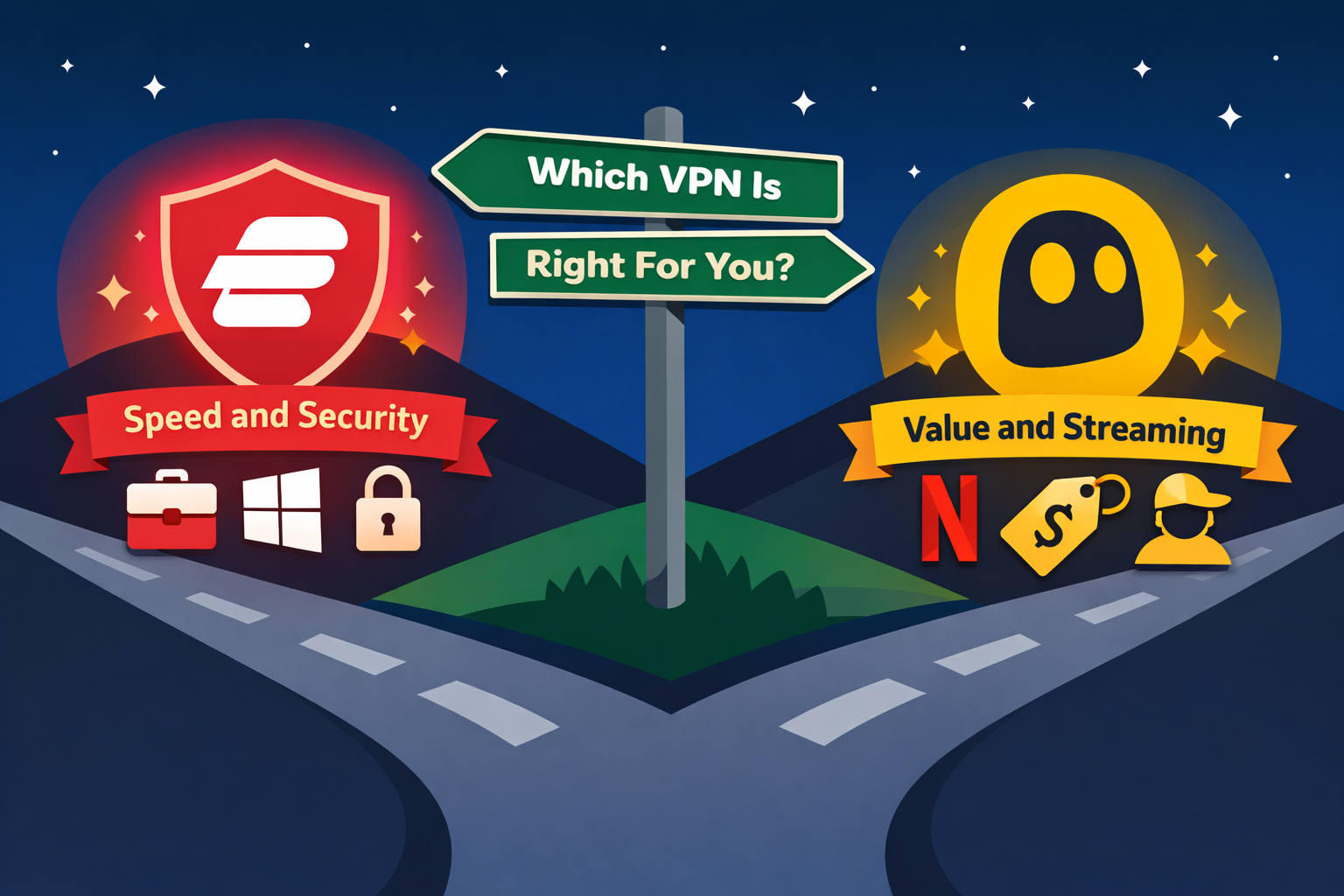
The expressvpn vs cyberghost debate comes down to this: you’re choosing between verified quality and accessible value.
ExpressVPN costs more and earns that cost through audited privacy, faster speeds, and a business-ready infrastructure. If you’re protecting company data or handling sensitive client information, the extra spend is justified. Plain-language security advice: pay for what you can verify, not just what sounds good in a press release.
CyberGhost is a legitimate, well-built VPN for personal use. If you’re a solo user who wants to stream content from other regions and keep your browsing private on public Wi-Fi, CyberGhost at its long-term pricing is a smart buy. The 45-day money-back guarantee means you can test it with zero risk.
Your actionable next steps:
- If you’re an SMB owner or IT manager, start with ExpressVPN’s 30-day trial and test it against your actual business workflows.
- If you’re a personal user focused on streaming or budget, sign up for CyberGhost’s long-term plan and use the 45-day window to run your own tests.
- Whichever you choose, pair it with strong passwords, multi-factor authentication, and up-to-date endpoint security. A VPN is your first line of defense, not your entire security stack.
No vendor bias here. Both products work. One works better for your specific situation, and now you know which one that is.
References
- Cure53. (2020). ExpressVPN Security Audit Report. https://cure53.de/
- Deloitte. (2022). CyberGhost No-Logs Audit. https://www.cyberghost.com/
- KPMG. (2023). ExpressVPN TrustedServer Audit. https://www.expressvpn.com/
- AV-TEST Institute. (2024). VPN Performance Benchmarks. https://www.av-test.org/
- CyberGhost. (2025). Transparency Report Q4 2025. https://www.cyberghost.com/transparency-report/
- ExpressVPN. (2025). TrustedServer Technology Overview. https://www.expressvpn.com/features/trustedserver