NordVPN vs Surfshark: Speed, Price & Privacy Compared
Quick Answer: NordVPN wins on speed, server count, and upload performance. Surfshark wins on price and unlimited device connections. Both pass independent audits and use military-grade encryption. For most SMB owners and privacy-focused users, NordVPN is the stronger all-around pick in 2026 — but Surfshark is a legitimate budget alternative if cost is your primary constraint.
Key Takeaways
- NordVPN retains 81% download speed vs Surfshark’s 77%, and crushes Surfshark on upload speed retention (69% vs 26%) [2][7]
- NordVPN’s NordLynx protocol averages 761 Mbps downloads; Surfshark’s WireGuard implementation falls noticeably behind [2]
- Surfshark costs $1.99/month on its longest plan vs NordVPN’s $2.69/month — a meaningful gap for budget-conscious buyers [1][2]
- Surfshark allows unlimited simultaneous device connections; NordVPN caps at 10 devices per account [2]
- NordVPN operates 8,400+ servers in 167+ countries vs Surfshark’s 4,500+ servers in 100 countries [2]
- Both use AES-256-GCM encryption and Perfect Forward Secrecy — encryption strength is a tie [2]
- Both passed independent Deloitte security audits in 2025 with verified no-logs policies [2]
- NordVPN is based in Panama (outside 14 Eyes); Surfshark is based in the Netherlands (inside EU jurisdiction) [2]
- Both offer 30-day money-back guarantees, so you can test either risk-free [2]

How Does NordVPN vs Surfshark Compare on Speed?
NordVPN is faster. That’s the short answer, and the test data backs it up consistently.
Independent testing by Cybernews measured NordVPN averaging 761 Mbps on downloads with 81% speed retention, compared to Surfshark’s 77% retention [2][7]. That gap sounds small until you look at upload speeds, where NordVPN retains 69% of baseline performance versus Surfshark’s 26% [2]. If you’re uploading large files, running video calls, or pushing data to cloud services, that difference is not trivial.
Protocol-Level Speed Breakdown
The protocol gap is where things get interesting. On OpenVPN specifically, NordVPN consistently delivers 200-270 Mbps while Surfshark lands between 70-90 Mbps [3]. That’s roughly 3 to 4 times faster on the same protocol, which matters if OpenVPN is your required standard for business compliance.
Why is NordVPN faster? NordVPN built NordLynx on top of WireGuard but added a double-NAT system that improves both privacy and throughput. Surfshark uses standard WireGuard, which is already fast, but doesn’t have the same optimization layer [2].
Choose NordVPN if: You’re running bandwidth-heavy operations, hosting video conferences, or your team regularly uploads large files to cloud storage.
Choose Surfshark if: Your primary use case is browsing, streaming, and light remote work where the speed gap won’t be noticeable in daily use.
“On upload speed retention, NordVPN holds 69% versus Surfshark’s 26% — a gap that matters the moment your team starts pushing data, not just pulling it.” [2]
How Do NordVPN and Surfshark Compare on Price?
Surfshark is cheaper, and by a noticeable margin on long-term plans.
Surfshark’s entry-level pricing starts at $1.99/month on its longest subscription, while NordVPN’s comparable plan runs $2.69/month [1][2]. Over two years, that difference adds up. Both providers offer identical 30-day money-back guarantees, so neither has an edge on risk-free trials [2].
Price Comparison Table
| Feature | NordVPN | Surfshark |
|---|---|---|
| Starting monthly price | $2.69/month | $1.99/month |
| Money-back guarantee | 30 days | 30 days |
| Simultaneous devices | 10 | Unlimited |
| Free tier available | No | No |
| Annual plan available | Yes | Yes |
The Device Count Factor
Surfshark’s unlimited device connections change the pricing math for households and small businesses. If you’re covering 15 employee laptops plus personal phones, Surfshark’s unlimited connections at a lower price point is a real advantage. NordVPN’s 10-device cap means you may need multiple accounts for larger teams, which quickly erases the price difference [2].
Common mistake: Buyers compare per-month prices without accounting for device count. Always calculate total cost per device, not just the plan price.
Which VPN Has the Better Server Network?
NordVPN’s network is nearly twice the size of Surfshark’s, and that matters for reliability and geo-unblocking.
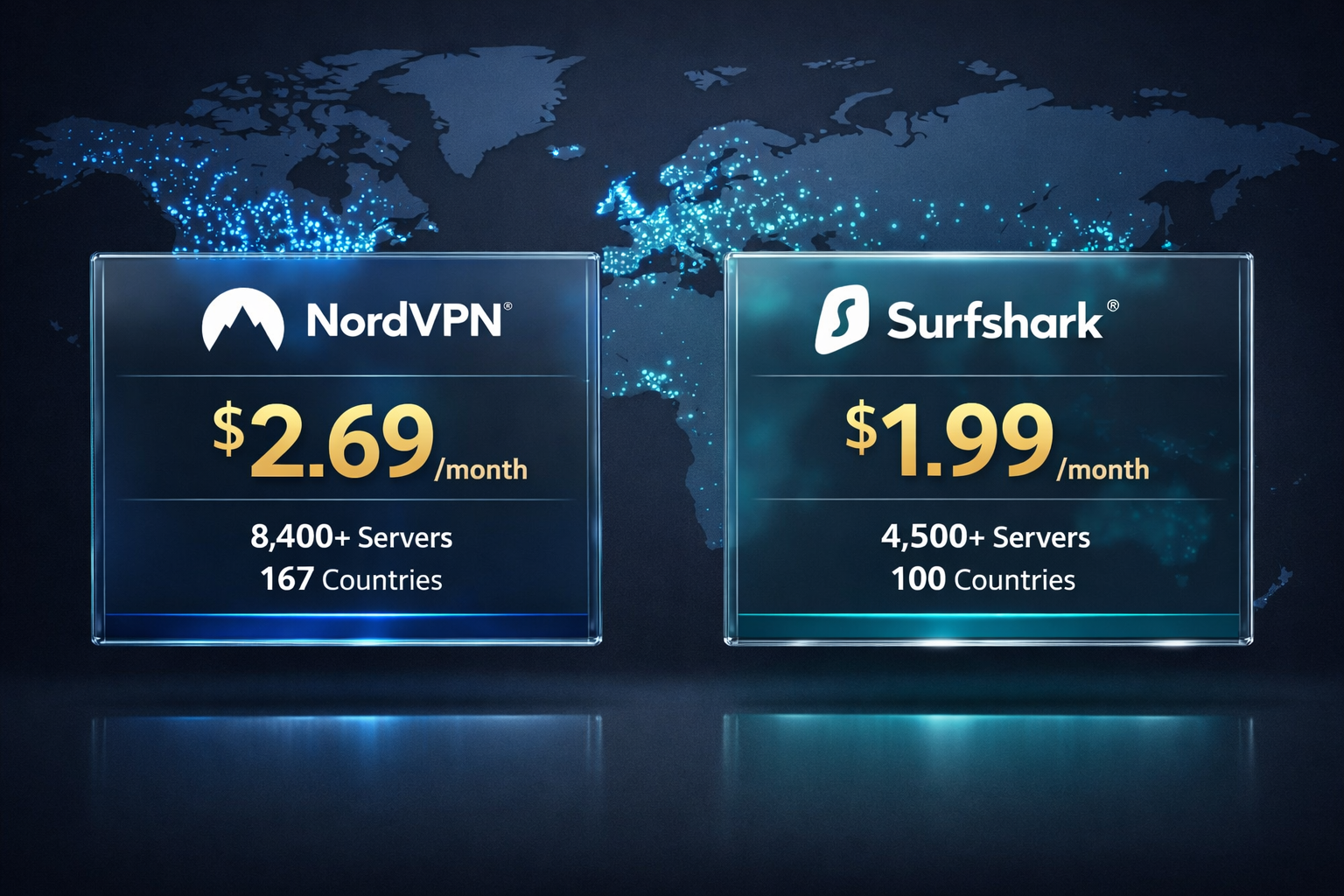
NordVPN operates 8,400+ servers across 167+ countries. Surfshark runs 4,500+ servers in 100 countries [2]. More servers mean less congestion during peak hours, more location options for bypassing geo-restrictions, and more fallback choices when a specific server is slow or down [5].
Why Server Count Matters for SMBs
For a business with remote teams across multiple regions, server density directly affects connection quality. A larger network reduces the odds that your team in Singapore and your team in Brazil are both fighting for the same overloaded server at 9 AM their respective local times.
Surfshark’s 100-country coverage handles most common use cases fine. But if your business operates in less common regions, or if you need specific city-level server selection, NordVPN’s 167+ country footprint gives you more options [2][5].
Edge case: Surfshark covers fewer countries, but its server quality within covered regions is solid. If you only need servers in major markets (US, UK, EU, APAC hubs), the gap shrinks considerably.
How Do NordVPN vs Surfshark Stack Up on Privacy and Security?
Both are genuinely strong on privacy. The differences come down to jurisdiction and architecture, not encryption quality.
On encryption, it’s a tie. Both use AES-256-GCM with ChaCha20 as an alternative cipher, and both implement Perfect Forward Secrecy, which rotates session keys so that compromising one key doesn’t expose past or future sessions [2]. This is tested and verified cryptographic practice, not marketing language.
Jurisdiction: Panama vs the Netherlands
NordVPN is incorporated in Panama, which sits outside the 14 Eyes intelligence-sharing alliance and has no mandatory data retention laws. Surfshark is based in the Netherlands, which is an EU member state and part of the 9 Eyes alliance [2].
In practice, both companies have verified no-logs policies audited by Deloitte in 2025 [2]. A no-logs policy means there’s no data to hand over even if authorities request it. But if you’re in a high-risk profession (journalist, activist, attorney handling sensitive cases), Panama jurisdiction adds a meaningful legal buffer.
Independent Audit Results
Both passed Deloitte’s independent security audit with verified no-logs compliance [2]. This is the kind of independent testing that actually matters. Vendor claims mean nothing without third-party verification.
NordLynx’s privacy architecture adds a double-NAT system that prevents IP address leakage at the protocol level, providing an extra layer of protection beyond what standard WireGuard offers [2]. Surfshark’s implementation is simpler but still sound.

Choose NordVPN if: Jurisdiction matters to your threat model, or you need the strongest possible privacy architecture.
Choose Surfshark if: You trust the audit results, operate in standard business contexts, and the Netherlands jurisdiction doesn’t concern you.
What Extra Features Do NordVPN and Surfshark Offer?
Both services have expanded well beyond basic VPN functionality. Here’s what’s actually useful versus what’s filler.
NordVPN Notable Features
- Threat Protection Pro: Blocks malware, trackers, and malicious ads at the DNS level without needing an active VPN connection
- Double VPN: Routes traffic through two servers for extra anonymity (useful for high-risk users)
- Onion over VPN: Combines VPN with Tor network routing
- Dedicated IP: Available as an add-on, useful for businesses needing consistent IP whitelisting
- Meshnet: Allows encrypted device-to-device connections, essentially a private network overlay
Surfshark Notable Features
- CleanWeb: Ad and tracker blocking built into the app
- Alternative ID: Generates fake personal details for online signups to protect real identity
- Surfshark Alert: Monitors email addresses for data breach exposure
- Camouflage Mode: Obfuscates VPN traffic so it looks like regular HTTPS traffic (useful in restrictive countries)
- NoBorders Mode: Automatically activates when restrictive network conditions are detected
For SMB owners specifically: NordVPN’s Dedicated IP and Meshnet features have real business utility. Dedicated IPs let you whitelist a consistent address for internal tools and remote access. Meshnet creates a private encrypted network between employee devices without needing a traditional VPN server setup.
Which VPN Is Better for Streaming?
Both unblock major streaming platforms, but NordVPN’s larger server network gives it a more consistent track record.
NordVPN’s 8,400+ servers provide more options to find a working connection when streaming platforms block specific server IP ranges, which they do regularly [2][5]. Surfshark works well for Netflix, Disney+, BBC iPlayer, and other major platforms, but with fewer servers, you may hit dead ends more often in less common regions [4].
Practical tip: If streaming is your primary use case and you’re only targeting major English-language platforms, Surfshark handles it fine at a lower price. If you need consistent access to regional content libraries across many countries, NordVPN’s depth wins.
Is NordVPN or Surfshark Better for Business Use?
For SMB use, NordVPN is the stronger choice. For budget-conscious teams with many devices, Surfshark is worth considering.
NordVPN’s Dedicated IP feature alone makes it more business-ready. You can whitelist a consistent IP address for your company’s internal tools, CRM, or remote desktop access. The Meshnet feature lets distributed teams create encrypted peer-to-peer connections without complex server infrastructure [6].
Surfshark’s unlimited device connections and lower price make it attractive for startups or small teams where every dollar counts and device count is high. The security fundamentals (encryption, no-logs, kill switch) are solid for standard business use.
SMB-ready checklist for VPN selection:
- Does it support dedicated IPs for IP whitelisting? (NordVPN yes, Surfshark limited)
- Does it have a kill switch on all platforms? (Both yes)
- Is there a verified no-logs audit? (Both yes, Deloitte 2025)
- Can it cover all employee devices? (Surfshark unlimited, NordVPN 10)
- Does jurisdiction match your compliance requirements? (NordVPN Panama, Surfshark Netherlands)
- Does it support split tunneling? (Both yes)
What Are the Main Drawbacks of Each VPN?
Nothing is perfect. Here’s what each service gets wrong.
NordVPN Weaknesses
- Higher price than Surfshark on comparable plans [1]
- 10-device limit means extra cost for large teams
- Past security incident (2018 server breach, though no user data was compromised) — worth knowing even though the company has since completed multiple audits
- Some advanced features (Dedicated IP, extra storage) cost more as add-ons
Surfshark Weaknesses
- Upload speed retention of 26% is a real problem for upload-heavy workflows [2]
- Netherlands jurisdiction puts it inside EU legal frameworks and 9 Eyes [2]
- Smaller server network means more congestion risk during peak hours [5]
- OpenVPN speeds (70-90 Mbps) lag significantly behind NordVPN [3]
FAQ: NordVPN vs Surfshark
Q: Which is faster, NordVPN or Surfshark? NordVPN is faster. It retains 81% of download speed and 69% of upload speed. Surfshark retains 77% download and only 26% upload. On OpenVPN, NordVPN is roughly 3-4 times faster [2][3].
Q: Which is cheaper, NordVPN or Surfshark? Surfshark is cheaper, starting at $1.99/month versus NordVPN’s $2.69/month on long-term plans. But Surfshark also allows unlimited devices, which changes the per-device cost calculation significantly [1][2].
Q: Do both have no-logs policies? Yes. Both NordVPN and Surfshark have independently audited no-logs policies, verified by Deloitte in 2025 [2].
Q: Which VPN is better for privacy? NordVPN has a slight edge due to its Panama jurisdiction (outside 14 Eyes) and NordLynx’s double-NAT privacy architecture. Surfshark’s Netherlands base puts it inside EU jurisdiction and 9 Eyes [2].
Q: How many devices can I connect simultaneously? Surfshark allows unlimited simultaneous connections. NordVPN allows up to 10 devices per account [2].
Q: Which VPN has more servers? NordVPN operates 8,400+ servers in 167+ countries. Surfshark has 4,500+ servers in 100 countries [2].
Q: Are both VPNs safe to use? Yes. Both use AES-256-GCM encryption, Perfect Forward Secrecy, and have passed independent security audits. Both are safe choices for personal and business use [2].
Q: Which VPN is better for small business? NordVPN is generally better for SMBs due to its Dedicated IP option, larger server network, and stronger privacy jurisdiction. Surfshark is a solid budget alternative for teams prioritizing device count over advanced business features.
Q: Do either VPNs work in China or restrictive countries? Surfshark’s Camouflage Mode and NoBorders feature are specifically designed for restrictive networks. NordVPN also has obfuscated servers. Both can work in restrictive environments, though results vary by location and timing.
Q: Can I try either VPN risk-free? Yes. Both NordVPN and Surfshark offer 30-day money-back guarantees with no questions asked [2].
Conclusion: Which VPN Should You Actually Buy?
After cutting through the vendor marketing on both sides, here’s the plain-language verdict.
Pick NordVPN if speed matters, you handle sensitive data, you need business features like Dedicated IP or Meshnet, or jurisdiction is part of your threat model. The higher price is justified by measurably better performance and a stronger privacy architecture. For SMB owners who treat their VPN as a real security tool rather than a checkbox, NordVPN is the right call.
Pick Surfshark if you’re covering many devices on a tight budget, your workflows are not upload-heavy, and you’re comfortable with EU jurisdiction. The unlimited device connections and $1.99/month entry price make it genuinely competitive for households and budget-conscious small teams.
Your action steps for today:
- Identify your primary use case: speed-heavy work, streaming, privacy, or device coverage
- Count your devices and calculate per-device cost for each plan
- Check whether your compliance requirements have any jurisdiction preferences
- Start a 30-day trial with your preferred option — both offer full refunds, so there’s no real risk
Both VPNs are legitimate. Neither is a scam. The nordvpn vs surfshark decision comes down to your specific priorities, not which brand has better marketing. Use the data above, match it to your actual workflow, and make the call.
References
[1] Surfshark Vs NordVPN – https://allaboutcookies.org/surfshark-vs-nordvpn [2] Surfshark Vs NordVPN – https://surfshark.com/blog/surfshark-vs-nordvpn [3] NordVPN Vs Surfshark – https://cyberinsider.com/vpn/comparison/nordvpn-vs-surfshark/ [4] NordVPN Vs Surfshark – https://www.vpnmentor.com/vpn-comparison/nordvpn-vs-surfshark/ [5] Surfshark Vs NordVPN – https://vpnpro.com/vpn-comparison/surfshark-vs-nordvpn/ [6] NordVPN Vs Surfshark – https://nordvpn.com/review/nordvpn-vs-surfshark/ [7] NordVPN Vs Surfshark – https://cybernews.com/best-vpn/nordvpn-vs-surfshark/ [8] Surfshark Vs NordVPN – https://www.esecurityplanet.com/networks/surfshark-vs-nordvpn/